


loader image

7QC Tools Consultant

At 7QC Tools, we specialise in providing companies with the necessary tools and methods to achieve top-quality management. The 7 Quality Control Tools are the basis for identifying and solving problems within any production process, helping communities improve efficiency, minimise errors, and keep the highest criteria of quality. Our complete services are tailored to meet the unique needs of each client, delivering expert advice and functional application of these tools to provide lasting improvements.

7QC Tools Consultant​

Why Choose a 7QC Tools Consultant

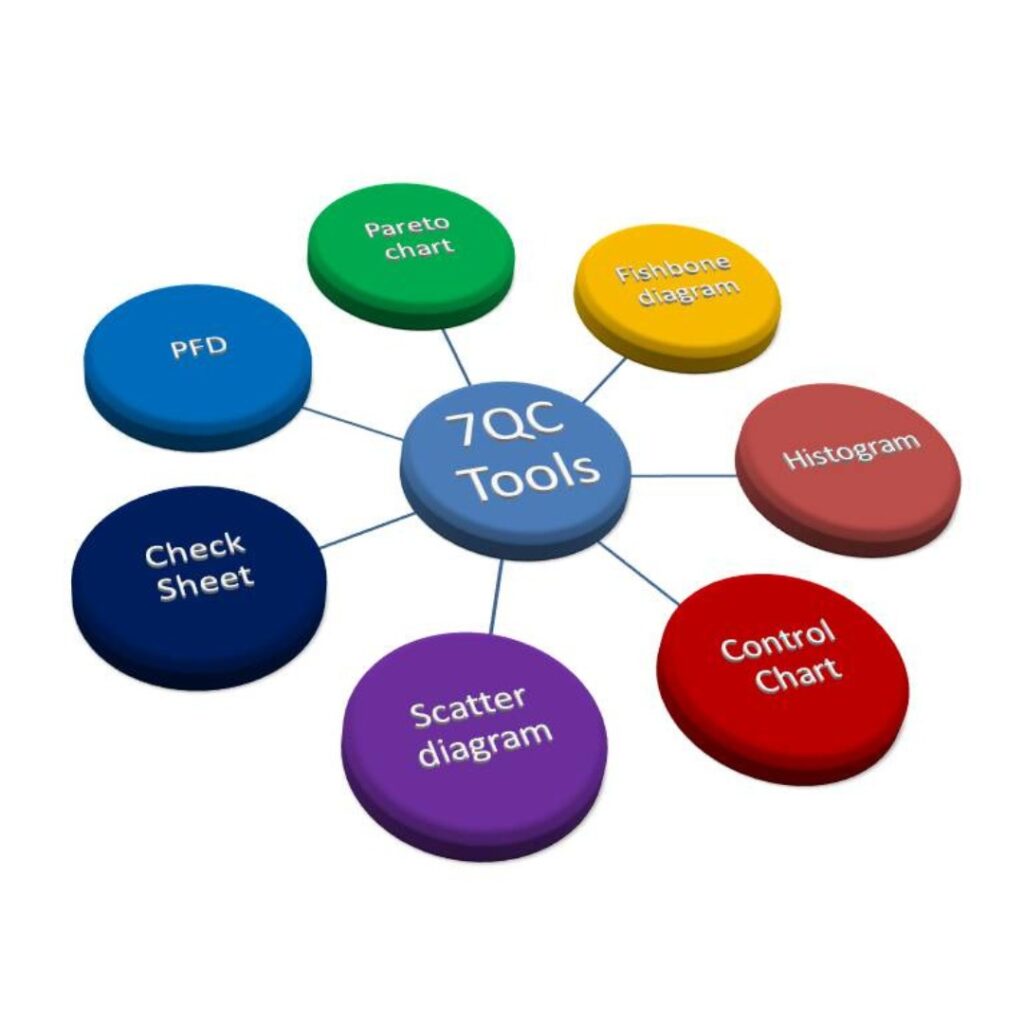
Choosing a 7QC Tools consultant ensures that your organization applies quality control techniques correctly, consistently, and with real business impact. An experienced consultant brings structured problem-solving, hands-on training, and practical implementation of tools like Pareto analysis, Fishbone diagrams, control charts, and histograms, helping teams move beyond theory to results. By using data-driven methods, a 7QC Tools consultant helps identify root causes, reduce variation, improve decision-making, and build a culture of continuous improvement that delivers sustainable performance gains across all levels of the organization.

How is Arrowhead raising the bar as a 7QC Tools Training Consultant in Mumbai, India?

Frequently Asked Question

Is training on 7 QC tools more suitable for beginners compared to Lean Six Sigma concepts?

Yes, training on the 7 QC tools is generally considered more suitable for beginners compared to full Lean Six Sigma concepts, as the 7 QC tools are simpler, more basic data analysis techniques that provide a solid foundation for understanding quality improvement methodologies before diving into the more complex framework of Lean Six Sigma. 

They are foundational to several process improvement methodologies, including Six Sigma and Total Quality Management (TQM). These seven basic tools of quality helps businesses to systematically categorise and analyse quality-related issues, pinpoint root causes, and implement solutions.

No, the 7 QC tools (quality control tools) are not solely relevant to manufacturing industries; they can be applied across various sectors like healthcare, finance, and service industries as well, as they are basic tools for data analysis and process improvement that can be used in any context where quality needs to be managed and improved. 
Key points about the 7 QC tools:
Versatility:
Their simplicity and ease of use make them valuable for anyone involved in quality management, regardless of industry. 
Data visualization:
The tools help visualize data to identify trends and root causes of problems, making them useful for analyzing processes in any field. 
Wide application:
While often associated with manufacturing, these tools can be used in service industries to analyze customer feedback, identify process inefficiencies, and improve service quality. 

The “7 QC tools” are considered basic, visual tools used for data collection and analysis to identify root causes of quality issues, while advanced quality management techniques involve more sophisticated statistical methods, often used for complex problem-solving and process optimization, requiring a deeper understanding of statistics and are typically used alongside the 7 QC tools in a comprehensive quality improvement approach. 

These seven basic tools of quality control. They require introductory-level knowledge (most of which we learn in school such as calculating mean, standard deviation, mode, median etc) of statistics. They are easy to understand and use, compared to advanced statistical methods such as hypothesis testing, regression analysis, etc.

Request a callback