
Introduction – When Speed Becomes the Real Competitive Advantage
Most organisations don’t struggle because they lack ideas.
They struggle because they cannot decide and act fast enough.
Markets move quickly.
Customer expectations evolve rapidly.
Operational disruptions happen without warning.
And yet, inside many organisations, decisions still move slowly.
- Meetings are held.
- Data is reviewed.
- Opinions are shared.
- Follow-ups are scheduled.
And somewhere in this process, momentum is lost.
The challenge is not intelligence.
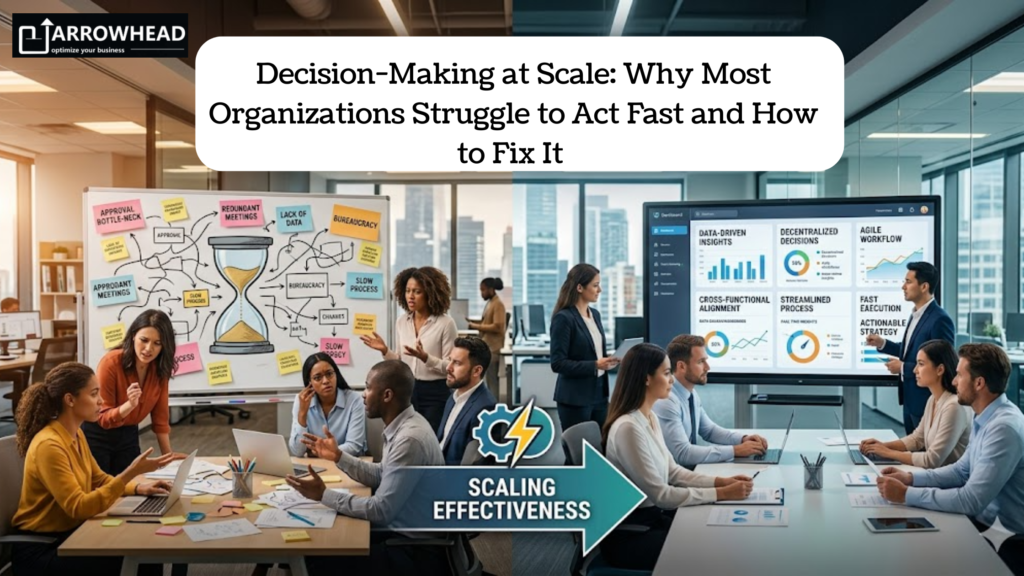
The challenge is decision-making at scale.
As organisations grow, decisions become:
- More complex
- More cross-functional
- More dependent on data
- More sensitive to risk
Without the right systems, this complexity slows everything down.
At ARROWHEAD Consulting, we see this pattern across industries. As an experienced Lean consultant in India, a trusted Six Sigma company in Mumbai, and among the leading Six Sigma Consultants in India, ARROWHEAD works with organisations that want to move beyond analysis and build the ability to decide and act consistently, quickly, and confidently.
This blog explores why decision-making slows down as organisations scale, what creates bottlenecks, and how disciplined systems enable faster, better decisions.
The Hidden Cost of Slow Decisions
Slow decision-making is rarely visible in financial reports, but its impact is significant.
It shows up as:
- Missed opportunities
- Delayed execution
- Increased operational cost
- Customer dissatisfaction
- Internal frustration
Consider a simple scenario:
A delay in approving a production change leads to:
- Lost output
- Increased backlog
- Customer delays
Or a delay in resolving a quality issue leads to:
- Rework
- Customer complaints
- Brand impact
These are not isolated issues. They are systemic outcomes of slow decision-making.
Organisations often focus on improving processes but overlook that decisions are what move them forward.
As a Six Sigma company in Mumbai, ARROWHEAD emphasises that improving decision speed can unlock performance gains across the entire organisation.
Why Decision-Making Slows Down as Organizations Grow
In smaller organisations, decisions are faster because:
- Fewer layers exist
- Communication is direct
- Ownership is clear
As organisations scale, new challenges emerge:
1. Increased Complexity
More products, more customers, more processes, and decisions require more inputs.
2. Cross-Functional Dependencies
Decisions often involve multiple teams:
- Sales
- Operations
- Finance
- Quality
Alignment becomes harder.
3. Risk Sensitivity
Larger organisations are more cautious. Decisions are reviewed multiple times to avoid mistakes.
4. Data Overload
More data is available, but not always structured or actionable.
5. Unclear Ownership
When multiple stakeholders are involved, responsibility becomes diffused.
These factors create friction, and friction slows decisions.
The Real Problem: Decision Systems, Not Decision Makers
Many organisations assume that slow decisions are caused by:
- Lack of leadership
- Lack of accountability
- Lack of urgency
While these may contribute, the real issue is often a lack of structured decision systems.
Without systems:
- Decisions depend on individuals
- Outcomes vary
- Speed is inconsistent
High-performing organisations don’t rely on individual brilliance.
They rely on repeatable decision-making frameworks.
This is where the expertise of a Lean consultant in India becomes critical, designing systems that simplify decisions rather than complicate them.
Understanding the Decision Bottlenecks
To improve decision speed, organisations must first identify where decisions get stuck.
1. Unclear Decision Points
Teams don’t know:
When a decision is required
What triggers it
Result: Delays and confusion.
2. Lack of Defined Ownership
When everyone is involved, no one is accountable.
Result: Decisions are unnecessarily postponed or escalated.
3. Misaligned Data
Different teams rely on different metrics.
Result: Conflicting interpretations and prolonged discussions.
4. Over-Reliance on Hierarchy
Decisions are escalated rather than resolved at the appropriate level.
Result: Bottlenecks at senior leadership.
5. No Standard Decision Process
Each decision is handled differently.
Result: Inconsistency and inefficiency.
As experienced Six Sigma Consultants in India, ARROWHEAD helps organisations identify and remove these bottlenecks through structured analysis and process redesign.
The Role of Data in Faster Decision-Making
Data is often seen as the solution, but it can also be part of the problem.
More data does not mean faster decisions.
Better structured data does.
High-performing organisations use data to:
- Clarify priorities
- Reduce ambiguity
- Enable quick comparisons
- Support confident decisions
They avoid:
- Data overload
- Unnecessary metrics
- Complex dashboards
As a Six Sigma company in Mumbai, ARROWHEAD emphasises:
- Defining critical metrics (CTQs)
- Aligning data across functions
- Linking data to specific decisions
Data should answer one question:
“What should we do next?”
Lean Thinking: Simplifying Decisions Through Flow
Lean is not just about efficiency; it is about clarity and flow.
In decision-making, Lean helps:
- Remove unnecessary steps
- Define clear handoffs
- Reduce delays
- Enable faster escalation
Lean asks:
- Where is the decision delayed?
- Why does it require multiple approvals?
- Can it be simplified?
As a Lean consultant in India, ARROWHEAD uses Lean principles to redesign decision flows, ensuring decisions happen at the right time and at the right level.
Six Sigma: Bringing Discipline to Decision-Making
While Lean simplifies, Six Sigma brings discipline.
It ensures that decisions are:
- Based on validated data
- Rooted in analysis
- Consistent across situations
Six Sigma prevents:
- Reactive decisions
- Emotional bias
- Inconsistent outcomes
As one of the leading Six Sigma Consultants in India, ARROWHEAD ensures that decision-making is not only fast but also reliable.
From Decision to Execution: Closing the Gap
Making decisions faster is only part of the solution.
Organisations must also ensure that decisions:
- Are clearly communicated
- Are acted upon quickly
- Lead to measurable outcomes
Common gaps include:
- Decisions not translated into action
- Lack of follow-through
- No tracking of impact
High-performing organisations link decisions directly to execution systems.
What High-Performing Organisations Do Differently
Organisations that excel in decision-making share common characteristics:
1. Clear Decision Frameworks
They define:
- Decision types
- Ownership
- Required data
2. Standardised Processes
Decisions follow consistent workflows.
3. Data Alignment
All teams use the same metrics.
4. Empowered Teams
Decisions are made at the right level, not always escalated.
5. Continuous Learning
Decisions are reviewed and improved over time.
This is the model ARROWHEAD Consulting helps build as both a Lean consultant in India and a Six Sigma company in Mumbai.
The ARROWHEAD Consulting Approach to Decision Excellence
ARROWHEAD focuses on building decision systems, not just improving decisions.
The approach includes:
1. Mapping Decision Flows
Understanding how decisions move across functions.
2. Defining Ownership
Clarifying who decides what.
3. Aligning Data
Creating a single version of truth.
4. Embedding Lean and Six Sigma
Combining speed with discipline.
5. Establishing Governance
Ensuring decisions are tracked and reviewed.
This approach ensures that decision-making becomes:
- Faster
- More consistent
- More effective
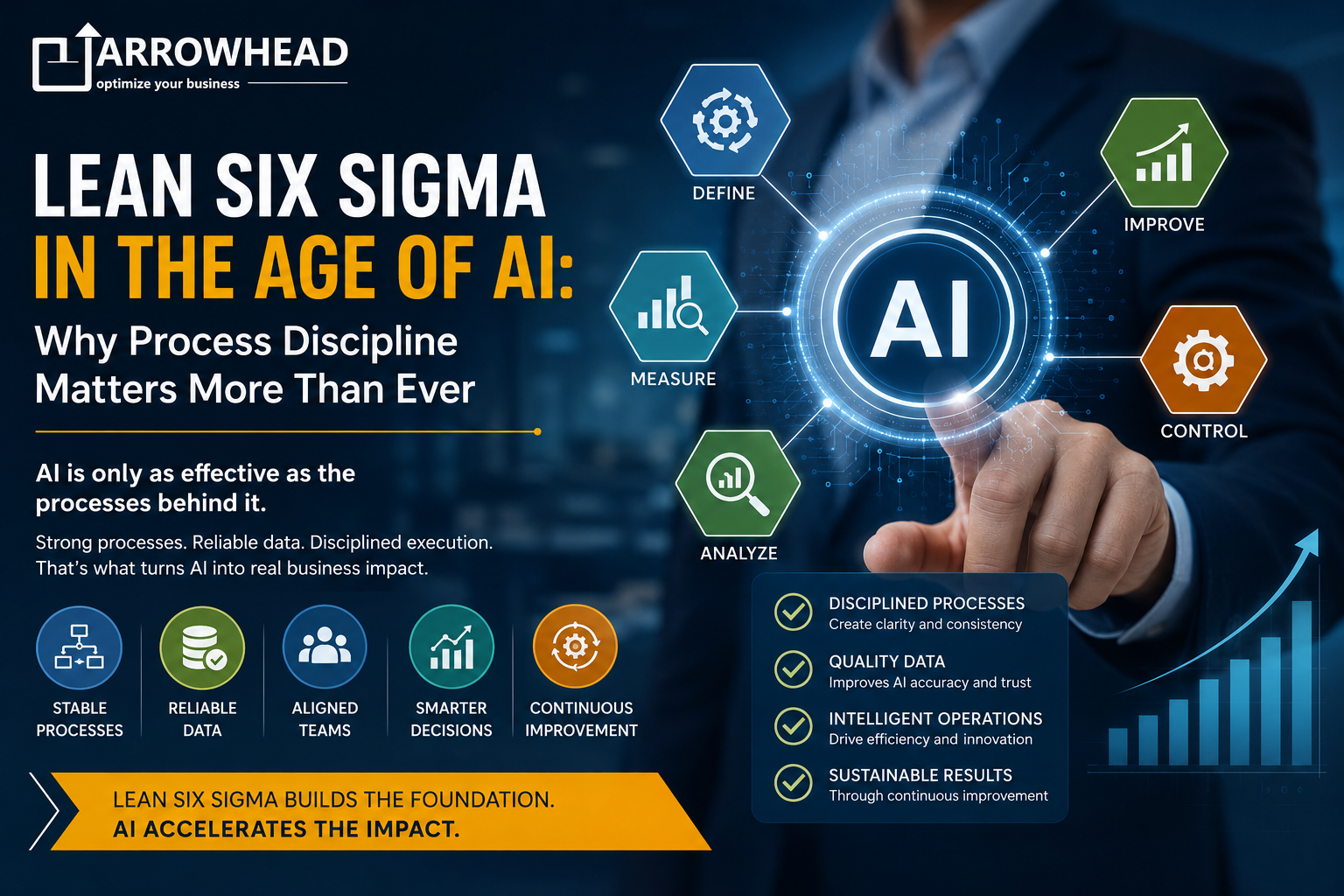
Why AI Alone Cannot Fix Decision-Making
AI can:
- Provide insights
- Predict outcomes
- Identify patterns
But it cannot:
- Align teams
- Define ownership
- Drive accountability
Without strong operational systems, AI adds complexity rather than clarity.
This is why organisations continue to rely on experienced Six Sigma Consultants in India to integrate technology with process discipline.
Building a Culture of Decisiveness
Ultimately, decision-making is not just a system; it is a culture.
Organisations must encourage:
- Ownership
- Accountability
- Speed
- Learning
Leaders play a critical role by:
- Trusting data
- Empowering teams
- Reducing unnecessary approvals
- Encouraging action
Conclusion – Speed Comes from Structure
Fast decisions are not the result of urgency.
They are the result of clarity, alignment, and discipline.
Organisations that:
- Define decision systems
- Align data
- Empower teams
- Integrate Lean and Six Sigma
are able to act faster and perform better.
At ARROWHEAD Consulting, this is the focus.
As a trusted Lean consultant in India, a leading Six Sigma company in Mumbai, and among the most experienced Six Sigma Consultants in India, ARROWHEAD helps organisations build systems that convert complexity into clarity and insight into action.
Because in today’s world, the organisations that win are not those that know the most.
They are the ones who decide and act the fastest