
Introduction – When Good Enough Is Not Good Enough
In most industries, mistakes are inconvenient.
They may result in:
- customer dissatisfaction
- additional costs
- delays
- rework
While undesirable, these consequences are often manageable.
But there are industries where mistakes carry a completely different weight.
A defect in a consumer product may generate a complaint.
A defect in an aircraft component could cost lives.
A process failure in a retail operation may affect revenue.
A process failure in a nuclear facility could have consequences lasting decades.
This distinction is important because it highlights a fascinating reality:
Some industries operate at performance levels that effectively push beyond traditional Six Sigma expectations.
Not because they are chasing statistical perfection, but because failure simply isn’t an acceptable option.
At ARROWHEAD Consulting, this concept is highly relevant to modern operational excellence. As an experienced Lean consultant in India and a trusted partner helping organisations build Lean Six Sigma capabilities, ARROWHEAD often encourages leaders to study industries where reliability is embedded into the culture, not merely measured through metrics.
The lessons from these high-reliability environments are valuable not only to aerospace or healthcare organisations but also to any business seeking sustainable excellence.
Understanding What Six Sigma Really Represents
Before discussing industries that operate beyond Six Sigma levels, it is important to understand what Six Sigma was originally designed to achieve.
At its core, Six Sigma is about:
- reducing variation
- improving consistency
- minimizing defects
- creating predictable outcomes
Its value lies in helping organisations move away from:
- guesswork
- inconsistency
- reactive management
toward:
- data-driven decision-making
- structured problem-solving
- stable processes
However, world-class performance is rarely achieved through statistical tools alone.
The most successful organisations combine:
- Lean thinking
- operational discipline
- strong leadership
- process ownership
- continuous learning
This is why ARROWHEAD Consulting positions Lean Six Sigma as an integrated operating philosophy rather than simply a collection of analytical methods.
The Rise of High-Reliability Organizations
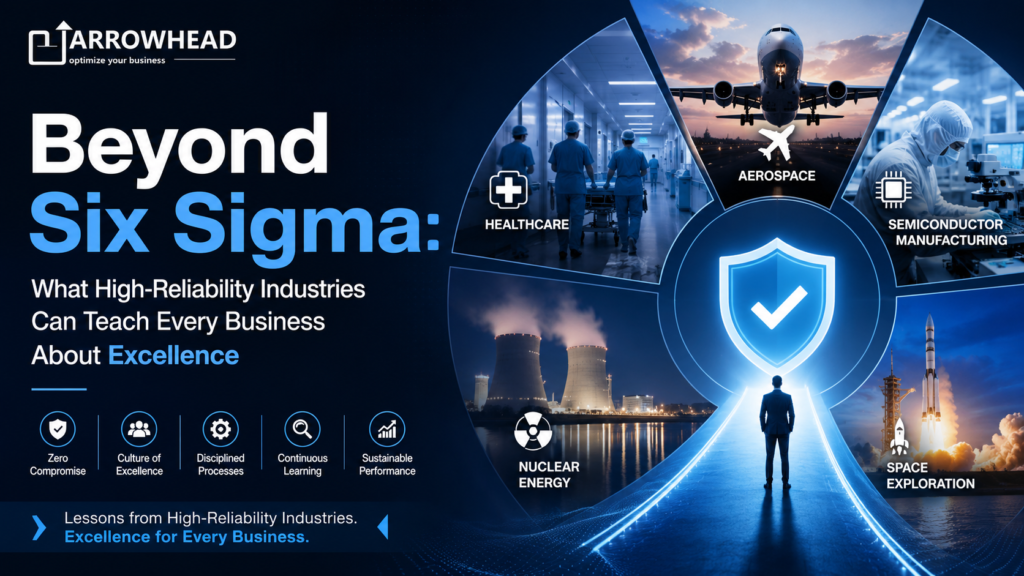
Researchers often refer to certain industries as High-Reliability Organisations (HROs).
These organisations operate in environments where:
- risk is high
- Complexity is significant
- consequences of failure are severe
Examples include:
- aerospace
- aviation
- healthcare
- nuclear power
- defense
- semiconductor manufacturing
- space exploration
Despite operating under extraordinary pressure, these organisations consistently achieve remarkable levels of reliability.
What makes them different?
The answer is not technology alone.
It is the combination of:
- culture
- discipline
- process excellence
- continuous improvement
Aerospace: Excellence When Failure Is Not an Option
Few industries demonstrate operational discipline better than aerospace.
Every aircraft contains thousands of components that must function correctly under demanding conditions.
Failure can have catastrophic consequences.
As a result, aerospace organisations emphasise:
Standardization
Processes are documented meticulously.
Deviation is controlled carefully.
Process Validation
Systems undergo extensive testing before implementation.
Continuous Learning
Incidents are studied rigorously.
Lessons are shared widely.
Risk Anticipation
Teams constantly ask:
What could go wrong?
This proactive mindset is one of the most powerful lessons Lean organisations can learn.
Rather than waiting for problems to occur, they actively design systems to prevent them.
Healthcare: The Pursuit of Zero Harm
Healthcare presents a unique challenge.
Unlike manufacturing environments, every patient is different.
Despite this complexity, leading healthcare institutions strive for extraordinary reliability.
They achieve this through:
Process Standardization
Critical procedures follow defined protocols.
Error Prevention Systems
Checks and safeguards are embedded into workflows.
Visual Management
Information is communicated clearly and consistently.
Continuous Improvement
Teams constantly review outcomes and identify opportunities to improve.
The healthcare industry’s focus on prevention rather than correction mirrors many Lean Six Sigma principles.
Semiconductor Manufacturing: Precision at Extraordinary Levels
Modern semiconductor production operates at astonishing levels of precision.
Microscopic defects can render products unusable.
To maintain quality, manufacturers rely on:
- highly controlled environments
- advanced process monitoring
- disciplined operating procedures
- rigorous root cause analysis
What makes this industry remarkable is its relentless focus on variation control.
Even minor inconsistencies are investigated because small deviations can create significant downstream consequences.
This commitment to precision offers an important lesson:
Excellence is often achieved by managing small details consistently rather than solving large problems occasionally.
Nuclear Energy: Building Systems Around Prevention
Nuclear facilities provide another powerful example of operational excellence.
These organisations understand that preventing problems is far more important than responding to them.
As a result, they invest heavily in:
- training
- procedures
- operational discipline
- leadership accountability
Their success depends on creating systems where:
- Abnormalities are identified early
- Concerns are raised immediately
- Continuous vigilance becomes cultural
Many organisations underestimate the value of preventive thinking.
Lean organisations understand that prevention is almost always more effective than correction.
What These Industries Have in Common
Although these industries differ significantly, they share several common characteristics.
1. They Focus on Systems, Not Individuals
High-reliability organisations rarely blame individuals for failures.
Instead, they examine:
- processes
- workflows
- decision systems
This systems-thinking mindset is central to Lean Six Sigma.
2. They Make Problems Visible
Issues are surfaced quickly.
Concerns are encouraged.
Visibility creates faster learning and better decision-making.
3. They Prioritise Learning
Every incident becomes an opportunity to improve.
Organisations that stop learning eventually stop improving.
4. They Value Standardisation
Standardisation is not viewed as bureaucracy.
It is viewed as a foundation for consistency and reliability.
5. They Embrace Continuous Improvement
Improvement is not treated as a project.
It becomes part of how the organisation operates.
This principle aligns closely with ARROWHEAD’s approach to Lean transformation.
Why Most Organizations Struggle to Reach Similar Levels
The challenge is not a lack of intelligence or capability.
The challenge is often organisational behaviour.
Many businesses:
- reward firefighting
- tolerate inconsistency
- Prioritise short-term results
- overlook process discipline
Over time, these habits create instability.
Even sophisticated technologies cannot compensate for weak operating systems.
This is why organisations frequently seek support from a Lean consultant in India to strengthen the operational foundations necessary for sustained performance.
The Role of Lean Six Sigma in Building High Reliability
Lean Six Sigma provides many of the capabilities needed to achieve higher reliability.
Lean contributes:
- process flow
- visibility
- waste reduction
- operational stability
Six Sigma contributes:
- analytical rigor
- variation control
- structured problem-solving
Together, Lean Six Sigma helps organisations:
- improve predictability
- reduce errors
- strengthen decision-making
- build operational discipline
However, the true value emerges when these principles become part of the culture rather than isolated improvement projects.
Why Culture Matters More Than Tools
One of the most important lessons from high-reliability industries is that culture ultimately determines performance.
Tools are important.
Technology is valuable.
Analytics provide insight.
But culture determines:
- how people behave
- how decisions are made
- How problems are addressed
Organisations that build:
- accountability
- transparency
- ownership
- learning
Create environments where excellence can thrive.
The ARROWHEAD Consulting Perspective
At ARROWHEAD Consulting, operational excellence is not viewed as a destination.
It is viewed as an ongoing capability.
The objective is not to achieve a statistical benchmark and stop.
The objective is to create organisations that continuously:
- learn
- improve
- adapt
- perform
As a trusted Lean consultant in India, ARROWHEAD helps organisations build Lean operating systems that strengthen reliability, improve performance, and create long-term business resilience.
The focus is always on creating sustainable excellence rather than short-term gains.
What Every Organisation Can Learn
Most organisations do not operate aircraft.
Most organisations do not manage nuclear reactors.
Most organisations do not manufacture semiconductors.
But every organisation can learn from the principles that drive these industries’ success.
The lessons are remarkably universal:
- Make problems visible.
- Standardise critical work.
- Build disciplined processes.
- Learn continuously.
- Improve systematically.
- Focus on prevention.
- Strengthen operational culture.
These practices create performance advantages regardless of industry.
Conclusion – Excellence Is a Habit, Not a Metric
The most reliable organisations in the world do not achieve excellence by chasing perfection.
They achieve excellence by creating systems that make high performance repeatable.
They understand that:
- discipline matters
- culture matters
- learning matters
- process matters
The lesson for modern organisations is clear.
Operational excellence is not achieved through occasional improvement projects.
It is achieved through consistent behaviours, strong operating systems, and a commitment to continuous improvement.
At ARROWHEAD Consulting, this philosophy sits at the heart of every Lean Six Sigma engagement.
Because while very few organisations need to operate an aircraft or manage a nuclear facility, every organisation can benefit from building the reliability, discipline, and operational maturity that world-class industries demonstrate every day.
And that is ultimately what sustainable excellence looks like.