
Introduction – The AI Race Has Begun, but Most Organizations Are Still Operationally Unprepared
Across industries, organisations are rushing to adopt AI
Leadership teams are discussing:
- predictive analytics
- machine learning
- automation
- intelligent dashboards
- AI-driven operations
Technology vendors promise:
- faster decisions
- smarter systems
- lower costs
- better forecasting
And while AI is undoubtedly transforming business, many organisations are quietly discovering an uncomfortable reality:
AI does not automatically create operational excellence
In fact, when weak processes meet advanced technology, organisations often become faster at creating confusion rather than better at creating value.
- Data becomes inconsistent.
- Dashboards multiply.
- Teams interpret information differently.
- Decisions become fragmented.
The issue is not the technology itself.
The issue is that AI requires something many organisations still lack:
process discipline.
This is where Lean Six Sigma becomes more relevant than ever.
At ARROWHEAD Consulting, this shift is becoming increasingly visible across industries. As an experienced Lean consultant in India and a trusted partner for organisations pursuing Lean Six Sigma transformation, ARROWHEAD works with businesses seeking to integrate AI into operations without compromising process clarity, operational stability, or execution discipline.
This blog explores why Lean Six Sigma matters even more in the age of AI, how process discipline determines the success of intelligent systems, and why organisations that ignore operational foundations often struggle to unlock real value from technology investments.
The Biggest Misconception About AI in Operations
Many organisations believe AI can fix operational problems automatically.
The assumption often sounds like this:
- “Once we have enough data, AI will optimise the system.”
- “Automation will eliminate inefficiency.”
- “Predictive analytics will improve performance.”
But AI is not magic.
AI systems learn from:
- existing data
- existing workflows
- existing operational behavior
If those systems are:
- inconsistent
- fragmented
- unstable
- poorly governed
Then AI simply amplifies those weaknesses.
For example:
- Inconsistent process execution creates unreliable data
- Unclear ownership creates conflicting inputs
- Unstable workflows generate inaccurate predictions
Without operational discipline, intelligent systems become unreliable very quickly.
This is why organisations working with a skilled Lean consultant in India are increasingly focusing on operational readiness before large-scale AI deployment.
Why Lean Six Sigma Is Becoming More Important, Not Less
Some organisations mistakenly assume AI will replace Lean Six Sigma.
In reality, AI increases the need for Lean Six Sigma thinking.
Why?
Because AI performs best in environments where:
- processes are stable
- workflows are clearly defined
- variation is controlled
- The data is reliable
- decisions follow structured logic
These are precisely the strengths Lean Six Sigma creates.
Lean provides:
- flow
- visibility
- process clarity
- waste reduction
Six Sigma provides:
- analytical discipline
- variation control
- structured problem-solving
- data integrity
Together, Lean Six Sigma creates the operational foundation that allows AI to generate meaningful impact.
Without this foundation:
- AI recommendations are mistrusted
- Automation becomes inconsistent
- insights fail to translate into action
At ARROWHEAD Consulting, Lean Six Sigma is increasingly being used as the operational backbone for AI-enabled transformation.
AI Needs Stable Processes to Learn Effectively
AI systems identify patterns.
But patterns become unreliable when processes vary excessively.
For example:
- If teams follow different workflows
- If approvals happen inconsistently
- If data entry standards vary
- If operational routines are unstable
Then AI models struggle to distinguish meaningful signals from operational noise.
This creates:
- poor predictions
- unreliable recommendations
- inconsistent automation outcomes
Organisations often blame AI when the real issue is process inconsistency.
Lean Six Sigma helps reduce this instability by:
- standardizing workflows
- clarifying decision paths
- reducing unnecessary variation
This operational consistency dramatically improves the quality of AI-driven insights.
Why Data Quality Is an Operational Problem, Not Just a Technology Problem
Many organisations treat data quality as an IT issue
In reality, poor data quality is usually a symptom of poor operational discipline.
Examples include:
- inconsistent process execution
- unclear ownership
- duplicate workflows
- manual workarounds
- weak standardization
AI systems depend heavily on data quality.
If operational behaviours generate poor data:
- Dashboards become unreliable
- forecasts become inaccurate
- Automated decisions become risky
As a trusted Lean consultant in India, ARROWHEAD focuses on improving the operational systems that generate data — not just the technology consuming it.
Because better AI begins with better operational behaviour.
The Difference Between Automation and Intelligent Operations
Many organisations automate tasks without improving the process itself.
This creates:
- faster inefficiency
- automated waste
- digital complexity
True intelligent operations require something different:
- simplified workflows
- clear value streams
- stable decision systems
- disciplined execution
Lean thinking becomes critical here.
Lean asks:
- Why does this step exist?
- Does this activity create value?
- Can this process flow more smoothly?
Only after these questions are addressed should automation be scaled.
At ARROWHEAD Consulting, Lean Six Sigma is used to ensure that AI supports operational excellence rather than simply digitising inefficiency.
Why Process Visibility Matters More in the AI Era
AI-driven environments generate enormous amounts of information.
Without visibility:
- Teams become overwhelmed
- priorities become unclear
- decisions slow down
Lean operating systems create visibility through:
- structured workflows
- visual management
- clear escalation paths
- standardized reporting
This visibility allows organisations to:
- trust insights faster
- Identify abnormalities early,
- coordinate decisions effectively
In the age of AI, visibility is no longer optional — it is essential.
The Human Side of AI Transformation
One of the biggest mistakes organisations make is treating AI transformation as purely technological.
In reality, successful AI adoption is deeply human.
Employees must:
- trust the data
- understand the process
- know how to respond to insights
- collaborate across functions
Without operational culture and process discipline:
- AI adoption resistance increases
- teams bypass systems
- decisions revert to intuition
Lean Six Sigma helps create:
- operational confidence
- structured problem-solving behavior
- cross-functional alignment
This cultural stability is what allows AI initiatives to scale successfully.
Why Lean Organizations Adapt Faster to Technological Change
Organisations with strong Lean operating cultures are naturally better prepared for AI transformation because they already possess
- structured workflows
- operational transparency
- disciplined management systems
- continuous improvement behaviours
This allows them to:
- integrate new technologies faster
- adjust workflows more smoothly
- learn from operational data continuously
Organisations lacking these foundations often struggle because AI exposes previously hidden operational weaknesses.
The Role of Leadership in AI-Enabled Lean Transformation
Leadership teams often focus heavily on technology selection.
But the real leadership challenge is:
- aligning operations
- simplifying complexity
- building execution discipline
Leaders must ask:
- Are our processes stable enough for automation?
- Do teams trust operational data?
- Are workflows standardised?
- Is ownership clearly defined?
Without these foundations, AI initiatives often fail to scale.
This is why ARROWHEAD Consulting emphasises Lean operating maturity before large-scale AI deployment.
What High-Performing Organisations Do Differently
Organisations successfully integrating AI with Lean Six Sigma typically:
- simplify before automating
- standardise before digitising
- stabilise before scaling
- Align teams before implementing technology
They understand:
Technology amplifies the operating system already in place.
If the system is disciplined, AI accelerates performance.
If the system is fragmented, AI accelerates dysfunction.
The ARROWHEAD Consulting Approach to Lean Six Sigma and AI
ARROWHEAD Consulting approaches AI-enabled transformation through a Lean operational lens.
The focus includes:
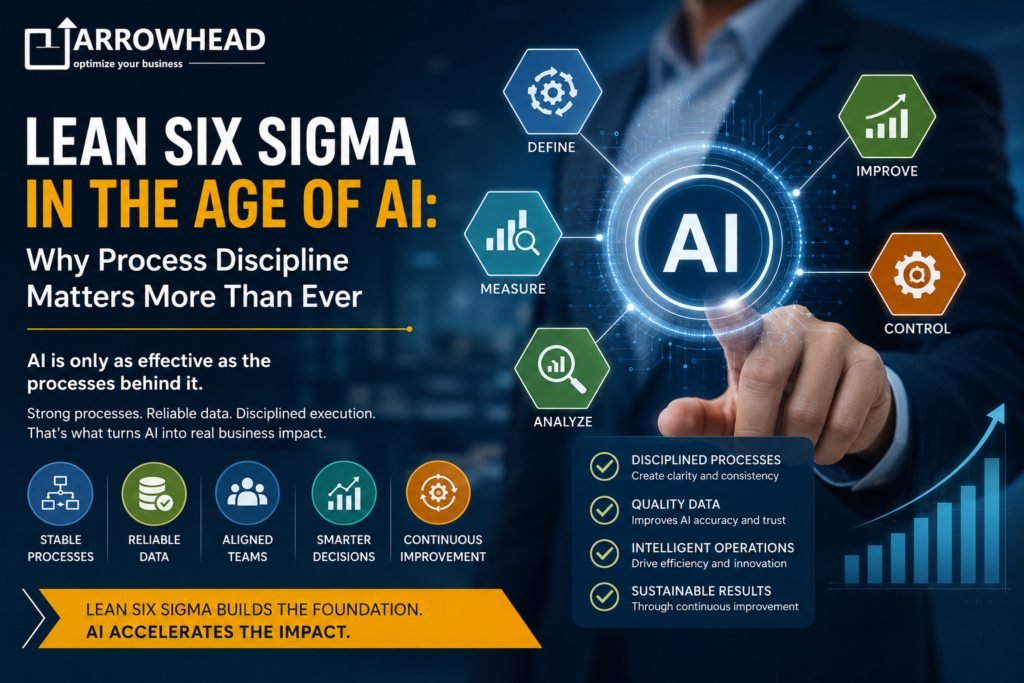
1. Process Stability
Ensuring workflows are disciplined and repeatable.
2. Data Reliability
Improving operational data quality at the source.
3. Cross-Functional Alignment
Creating shared operational understanding.
4. Lean Flow Optimisation
Removing inefficiencies before automation.
5. Structured Decision Systems
Ensuring insights lead to action.
This integrated approach allows organisations to adopt AI while maintaining operational control and clarity.
Why AI Will Never Replace Lean Thinking
AI can:
- analyze faster
- predict patterns
- automate decisions
But AI cannot:
- define value
- build culture
- create accountability
- establish operational discipline
These remain fundamentally human and organisational challenges.
Lean thinking continues to matter because it teaches organisations:
- How work should flow
- How teams should collaborate
- How problems should be solved
- How systems should improve continuously
This makes Lean Six Sigma even more valuable in the AI era.
The Future: Lean Six Sigma as the Foundation of Intelligent Operations
The future of operational excellence will not be:
Lean versus AI
or
Six Sigma versus automation
It will be:
Lean Six Sigma enables intelligent operations.
Organisations that combine:
- Lean flow
- operational discipline
- data reliability
- AI-driven insights
will create systems that are:
- faster
- smarter
- more adaptive
- more resilient
This is where operational excellence is heading.
Conclusion – Process Discipline Is the Real Competitive Advantage
As organisations adopt AI, many will focus primarily on technology.
But the organisations that succeed long-term will understand something deeper:
Technology is only as effective as the operating system behind it.
Without:
- stable processes
- disciplined workflows
- reliable data
- aligned decision-making
AI cannot deliver sustainable value.
At ARROWHEAD Consulting, Lean Six Sigma is viewed not as an old methodology competing with technology, but as the operational foundation that allows intelligent systems to perform effectively.
As a trusted Lean consultant in India, ARROWHEAD helps organisations build operational environments where:
- AI insights become actionable
- processes remain stable
- Teams stay aligned
- improvement becomes continuous
Because in the age of AI, the organisations that win will not simply be the most digital
They will be the ones with the strongest operational discipline behind their technology.