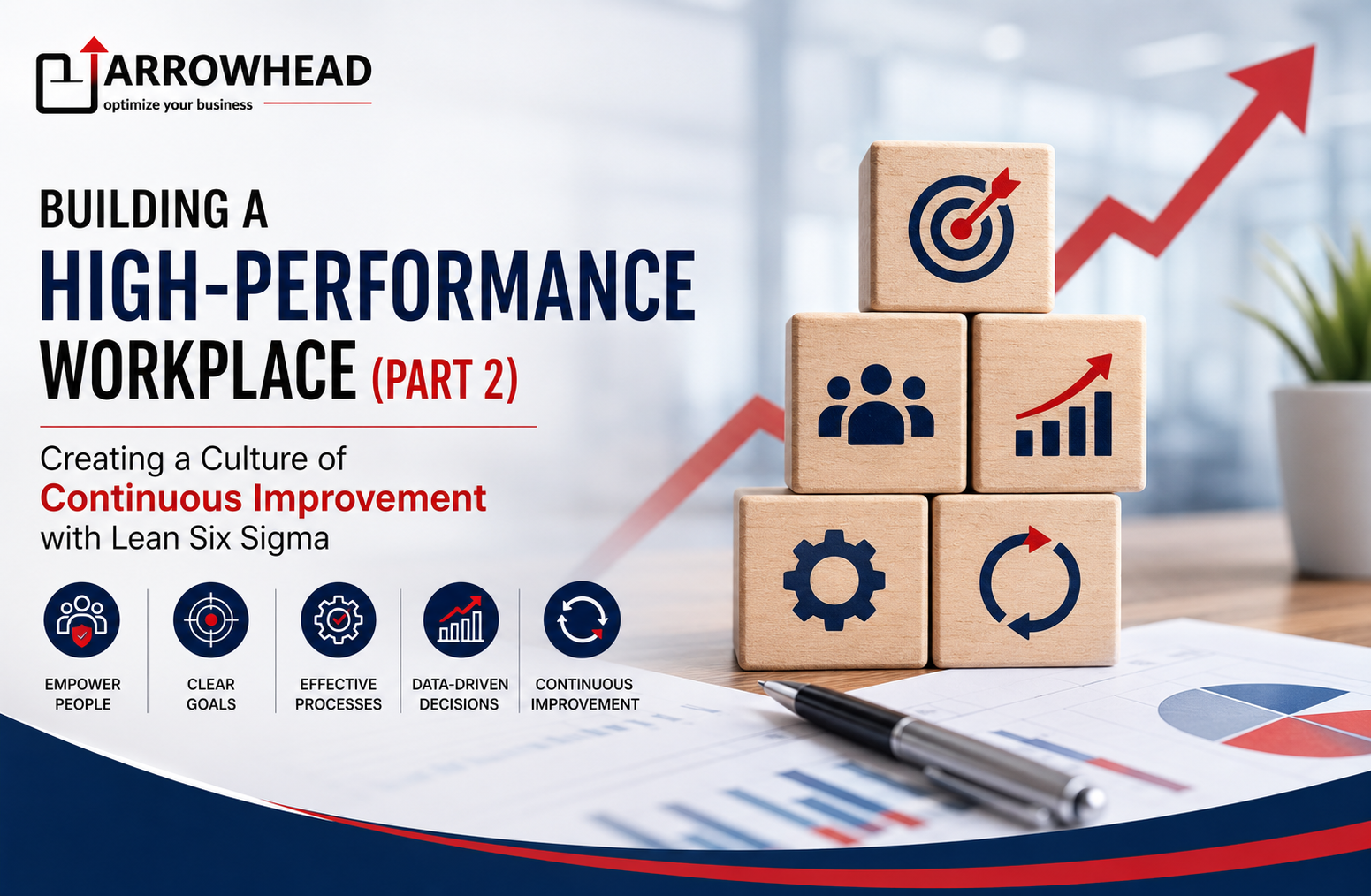

Introduction: High Performance Is Not About Having More High Performers
Ask any leadership team whether they want a high-performance workplace, and the answer will almost certainly be yes.
Organizations want people who take ownership. They want departments to collaborate. They want decisions to move faster, problems to be solved earlier, and customers to experience consistently good service.
The intention is rarely missing.
The challenge is creating a workplace where all of this happens naturally and consistently.
Many organizations assume that high performance comes from hiring highly capable people. Find the best talent, set ambitious targets, introduce performance incentives, and results should follow.
But real organizations rarely work that simply.
You can have an excellent sales team and still disappoint customers because operations cannot meet the commitments being made.
You can have a highly efficient production team and still struggle with margins because procurement, planning, and inventory decisions are disconnected.
You can have outstanding technology teams and still deliver projects late because business requirements keep changing.
Individually, every department may be working hard.
Collectively, the organization may still underperform.
This is the uncomfortable truth behind many performance challenges:
A collection of high-performing individuals does not automatically create a high-performance workplace.
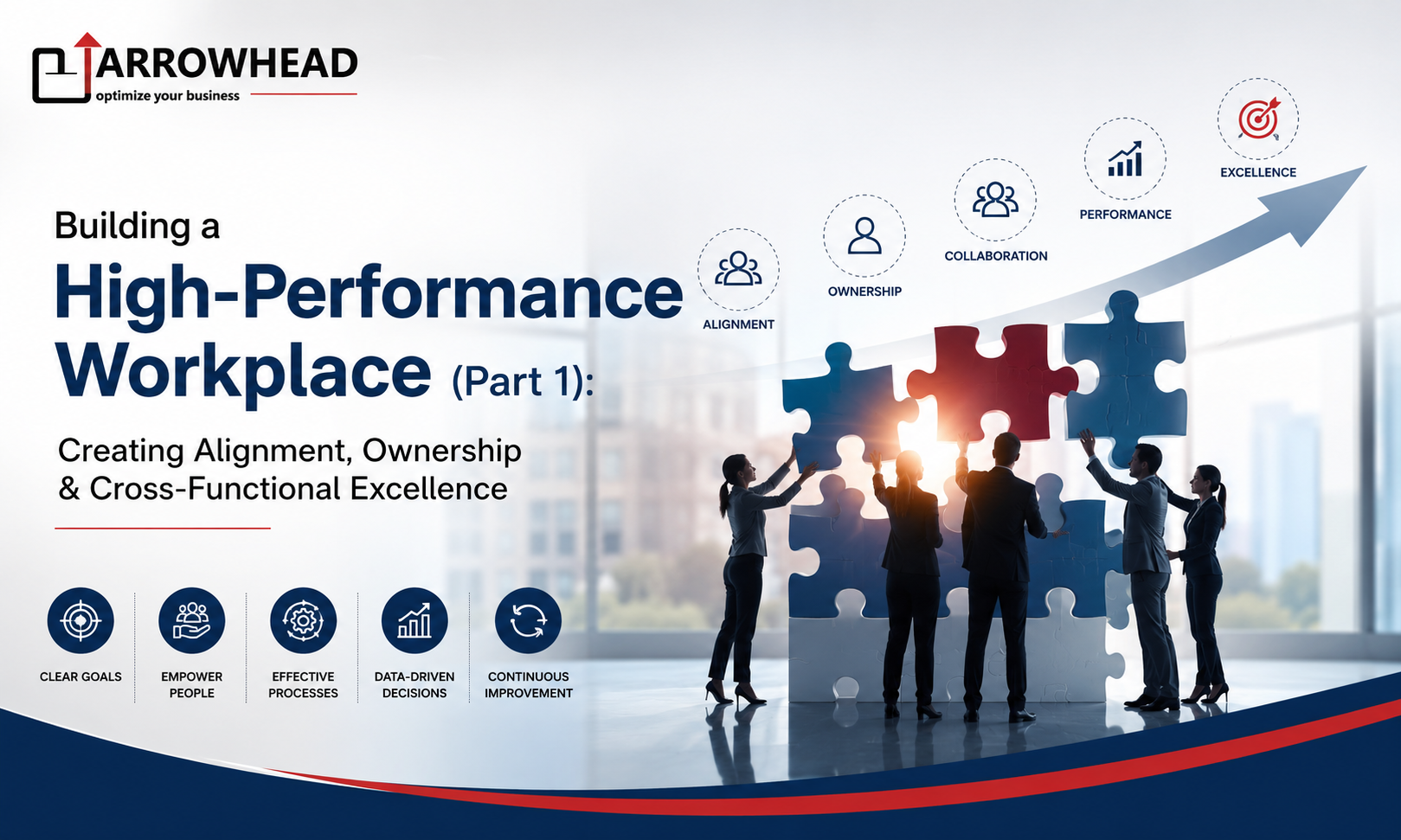
High performance is created by the way people, departments, processes, information, and decisions work together.
At ARROWHEAD Consulting, this distinction is central to our approach to operational excellence. As an experienced Lean consultant in India, ARROWHEAD Consulting helps organizations look beyond isolated departmental efficiency and understand the complete flow of value across the business.
Lean Six Sigma concepts can play a powerful role in this transformation. Not by turning every employee into a process expert or asking every problem to become a formal project, but by creating an environment built around clarity, flow, ownership, data, and continuous learning.
So what does a genuinely high-performance workplace look like?
And more importantly, how can organizations deliberately build one?
First, What Do We Mean by a High-Performance Workplace?
The phrase “high performance” is used very loosely.
For some organizations, it means achieving aggressive targets.
For others, it means higher productivity.
Some associate it with employee engagement, while others see it primarily through profitability or customer satisfaction.
In reality, a high-performance workplace brings all these elements together.
It is an environment where:
- People understand how their work contributes to business goals
- Departments work towards shared outcomes
- Information moves quickly and accurately
- Problems are made visible early
- Employees have the confidence to take ownership
- Decisions are supported by facts
- Leaders create clarity rather than dependency
- Improvement becomes part of normal work
Most importantly, high performance is repeatable.
One excellent quarter does not make a high-performance organization.
One extraordinary project does not create a high-performance culture.
A team working nights and weekends to recover a delayed order may achieve the target, but that is not necessarily high performance. In fact, repeated heroics are often evidence of a weak operating system.
A high-performance workplace produces strong results without constantly depending on crisis management.
That difference is important.
LEAN thinking asks organizations to study the system that creates performance, not just the final performance number.
Why Hard-Working Organizations Still Underperform
One of the most difficult situations for leaders is seeing teams work extremely hard while business results remain inconsistent.
People are busy.
Calendars are full.
Meetings continue throughout the day.
Emails move constantly.
Everyone appears occupied.
Yet delays continue. Customers escalate. Projects miss deadlines. Costs increase.
Why?
Because activity and value creation are not the same thing.
A significant amount of organizational effort is often consumed by:
- waiting for approvals
- searching for information
- correcting errors
- clarifying responsibilities
- attending repetitive meetings
- managing conflicting priorities
- Following up between departments
- reworking incomplete tasks
From a LEAN perspective, these activities reveal friction in the flow of work.
Employees may be working hard within a badly designed system.
This is why simply demanding “more productivity” rarely creates sustainable improvement.
A skilled Lean consultant in India will often begin by asking a very different question:
What is preventing capable people from performing at their best?
That question shifts the conversation.
The problem is no longer automatically assumed to be employee motivation.
Instead, the organization begins examining processes, handoffs, priorities, decision systems, and leadership behaviours.
This is where the journey towards a high-performance workplace truly begins.
High Performance Lives Between Departments
Perhaps the most important characteristic of a high-performance workplace is the quality of interaction between departments.
Most organizations are structured vertically.
There is Sales.
Operations.
Finance.
Procurement.
Quality.
Human Resources.
Technology.
Supply Chain.
Each department has a leader, a team, objectives, and performance measures.
But customers do not experience an organization vertically.
They experience the business horizontally.
A customer order may move through sales, planning, procurement, operations, logistics, finance, and customer service.
Value flows across departments.
This creates one of the biggest challenges in modern organizations.
Departments are managed vertically, but performance is created horizontally.
Consider a common example.
Sales receives an urgent customer opportunity and commits to an aggressive delivery date.
From the sales perspective, this is good performance.
The order has been won.
Operations receives the requirement and discovers that existing capacity is already stretched.
Planning changes the production schedule.
Procurement is asked to accelerate material availability.
Finance questions the additional cost.
Quality faces pressure to complete inspections faster.
Logistics receives a last-minute dispatch requirement.
Everyone becomes busy.
Everyone becomes frustrated.
And everyone believes another department created the problem.
This is not primarily a people problem.
It is a system alignment problem.
A high-performance workplace creates mechanisms for departments to understand dependencies, evaluate trade-offs, and make decisions around shared business outcomes.
Lean Six Sigma thinking helps organizations see these end-to-end relationships more clearly.
The objective is not to make Sales less ambitious or Operations more accommodating.
The objective is to design a system where the right conversations happen before friction becomes a crisis.
The Problem with Local Optimization
One of the biggest enemies of high performance is local optimization.
Local optimization happens when a department improves its own metric at the expense of the wider organization.
Procurement may buy larger quantities to negotiate a lower unit price.
The procurement savings look excellent.
But inventory increases.
Warehouse space becomes constrained.
Working capital is blocked.
Some material eventually becomes obsolete.
Was the organization really more efficient?
Production may run large batches to maximize machine utilization.
The utilization metric improves.
But work-in-progress increases and customer lead times become longer.
Was performance genuinely better?
Customer service may close tickets quickly to improve response metrics.
But unresolved problems return as repeat complaints.
Was value actually created?
LEAN thinking challenges organizations to move beyond departmental efficiency and examine total value flow.
This is an important part of ARROWHEAD Consulting’s work as a Lean consultant in India.
A high-performance workplace cannot be built when every function is encouraged to win independently.
The organization must win together.
Shared Goals Create Shared Behaviour
If departments are measured against conflicting objectives, conflict should not surprise us.
People generally respond to the systems around them.
If Sales is rewarded only for revenue, aggressive commitments are predictable.
If Operations is measured only on efficiency, schedule flexibility may become difficult.
If Procurement is measured only on purchase price, larger buying quantities may appear attractive.
If Finance is measured heavily on cost control, investments in long-term capability may face resistance.
None of these departments is necessarily behaving irrationally.
Each is responding to its own definition of success.
High-performance workplaces deliberately create shared performance goals.
This does not mean eliminating functional metrics.
Departments still need specific measures.
But functional KPIs must connect clearly to broader business outcomes.
For example:
- customer lead time
- first-time-right performance
- order-to-cash cycle
- customer complaint resolution
- end-to-end productivity
- working capital
- service reliability
These measures naturally require collaboration.
No single department can improve them alone.
Lean Six Sigma provides a useful way of connecting process performance with measurable business outcomes. LEAN helps teams understand flow across the value stream, while Six Sigma tools can support deeper analysis where variation, data patterns, or complex root causes need to be understood.
The goal is not to force every business challenge into a Six Sigma project.
The goal is to use the right thinking and the right analytical tools for the problem at hand.
Ownership Is Different from Accountability on Paper
Almost every organization has job descriptions.
Most have reporting structures.
Many have RACI matrices.
Yet leaders still say:
“Nobody takes ownership.”
Why does this happen?
Because ownership is not created by writing a person’s name next to a task.
True ownership requires three things:
Clarity
The person understands what outcome they own.
Authority
They have sufficient decision-making power to influence that outcome.
Visibility
Performance and problems are visible enough for action to be taken.
Remove any one of these, and ownership becomes difficult.
Imagine making a process owner accountable for delivery performance while requiring five levels of approval to change the process.
The title says “owner”.
The system says “coordinator”.
High-performance workplaces align responsibility with authority.
LEAN operating systems make abnormalities visible and help move problem-solving closer to the point where work happens.
Employees should not need senior management intervention for every routine deviation.
At the same time, empowerment does not mean uncontrolled decision-making.
It means defining clear boundaries within which teams can act confidently.
This balance between standardization and empowerment is one of the strongest characteristics of mature LEAN organizations.
Final Thought
A high-performance workplace isn’t built by hiring harder or pushing people to work longer hours — it’s built by designing a system where clarity, ownership, and cross-functional alignment happen by default, not by heroics. When departments stop optimizing locally and start owning shared outcomes, performance becomes repeatable instead of accidental. That shift — from isolated effort to aligned flow — is where real, sustainable high performance begins.