
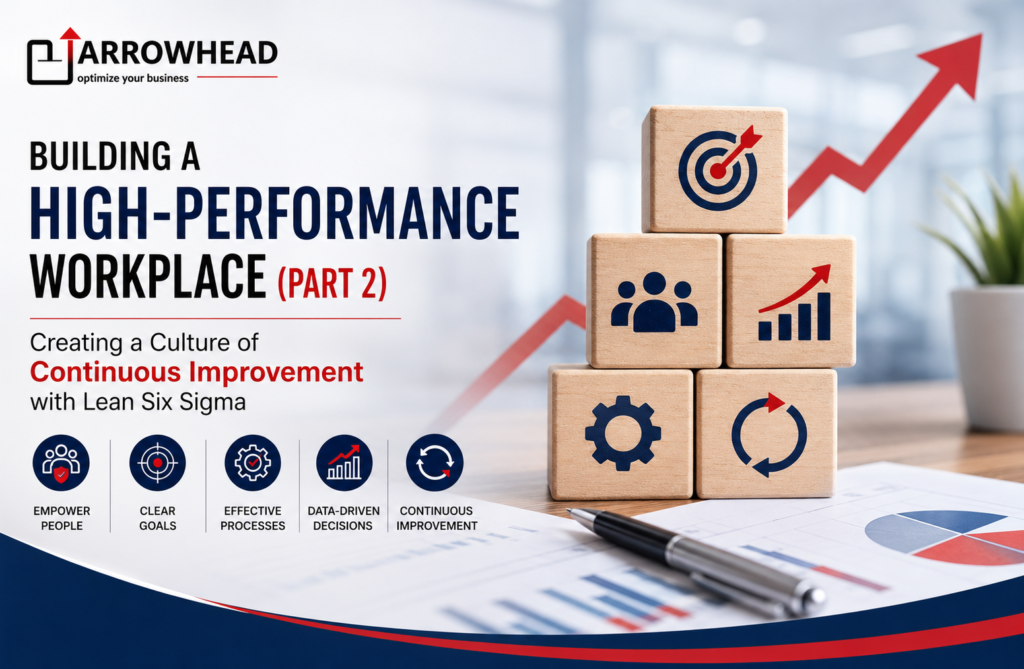
Psychological Safety and Operational Excellence Are More Connected Than We Think
Imagine a machine operator notices an unusual vibration. A customer service executive sees the same complaint appearing repeatedly. A finance analyst notices an unusual cost pattern. A junior project team member believes the delivery timeline is unrealistic. What happens next?
In a high-performance workplace, concerns move quickly. In a weak culture, people hesitate – “Maybe it’s not my place.” “I raised something last time, and nothing happened.” “I’ll wait and see.” That delay can be expensive.
LEAN cultures depend on problems becoming visible early, but processes cannot make problems visible if people are afraid to speak. This is why psychological safety is not merely an HR concept – it has a direct operational impact. Organizations that punish bad news often receive bad news late; organizations that encourage honest problem visibility gain more time to respond.
Lean Six Sigma problem-solving works best in environments where teams can discuss facts openly without immediately searching for someone to blame. The question should move from “Who caused this?” to “What in our process allowed this to happen?” That shift is where learning begins.
High-Performance Workplaces Make Problems Visible
Many organizations are uncomfortable with visible problems -a red metric feels negative, an escalation feels embarrassing, a missed target becomes something to explain away. High-performance organizations think differently: they understand that an invisible problem is far more dangerous than a visible one.
Visual management, daily performance reviews, and structured dashboards should not exist to prove that everything is fine. Their purpose is to show where reality differs from expectation – what has changed, where the abnormality is, who owns the next action, and whether the root cause is understood.
LEAN brings tremendous strength in creating this operational visibility. Where deeper analysis is required, Six Sigma tools help teams examine data, understand variation, and validate causes. LEAN creates the operating environment for continuous improvement; Six Sigma supports fact-based understanding when a problem demands greater analytical depth. This distinction is central to ARROWHEAD Consulting’s approach.
From Opinion-Based Meetings to Fact-Based Conversations
Many organizations spend enormous amounts of time in meetings, and the issue isn’t always the number of meetings -it’s the quality of conversation inside them. A typical operational discussion may sound like “I think demand suddenly increased,” “We had a supplier issue,” “The team is already overloaded.” Each statement may contain some truth, but opinions quickly create defensive conversations.
Data changes the nature of the discussion. When teams can see demand patterns, process cycle times, defect trends, and capacity constraints, the conversation becomes more objective. This is where the analytical strength of Lean Six Sigma becomes valuable – but analysis must serve the business problem. ARROWHEAD Consulting does not believe in making statistical analysis more complex than necessary; the purpose of data is to create clarity. Sometimes a simple Pareto chart reveals the priority, sometimes process observation reveals the waste immediately, and sometimes deeper statistical analysis is required. A mature improvement culture knows the difference – the method must fit the problem, not the other way around.
The Role of Leadership in a High-Performance Workplace
Leaders often say they want ownership, but leadership behaviour determines whether ownership actually develops. Consider two responses to a missed target:
- Response One: “How did you let this happen? Who is responsible? Fix it immediately.” The team learns one lesson -hide problems until you have a solution.
- Response Two: “When did the process first begin to deviate? What did the data show? What support is required?” The team learns a different lesson -understand the system and solve the problem.
Over time, these small interactions shape culture. High-performance leadership is not passive – standards, targets, and accountability still matter. But leaders understand that sustainable performance comes from improving the system, not creating fear around every deviation. In a LEAN environment, leaders spend more time understanding processes, asking better questions, and removing barriers. They do not become the answer to every problem; they build an organization capable of finding better answers.
Cross-Functional Relationships Cannot Depend on Personal Chemistry.
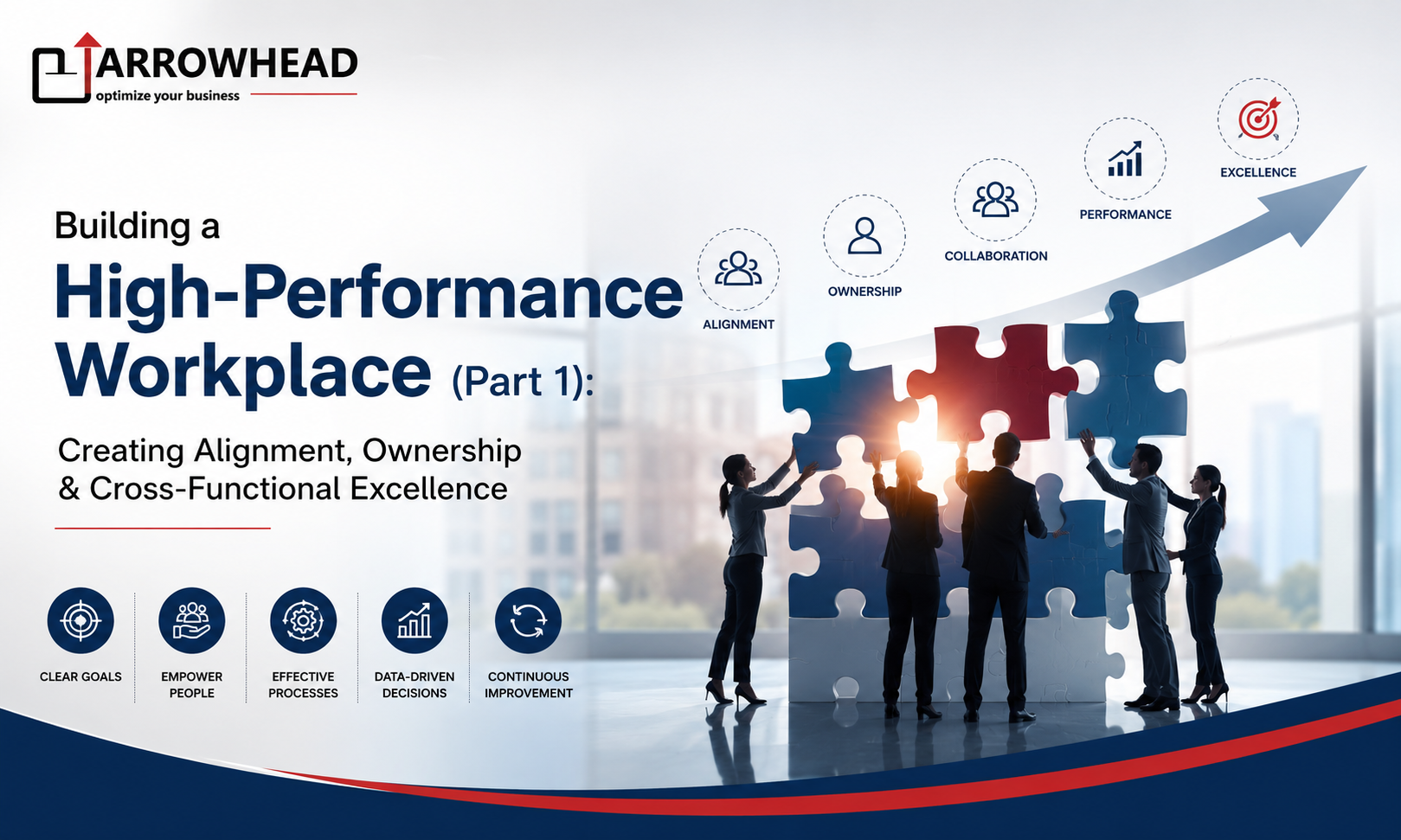
In many organizations, interdepartmental coordination works because certain people have strong personal relationships -the Sales Head calls the Operations Head directly, a planner knows someone in Procurement. These relationships can be helpful, but they are not an operating system. What happens when one person leaves, or the organization doubles in size, or teams operate across multiple locations?
High-performance workplaces design reliable interfaces between departments. They define:
- What information must be shared, and when
- Who owns each handoff, and what constitutes a complete one
- How abnormalities are escalated
- How conflicting priorities are resolved
LEAN value stream thinking is particularly useful here because it follows the movement of value rather than the boundaries of departments. The process becomes the focus, not the hierarchy.
Standardization Does Not Kill Innovation
One concern often raised about LEAN is that standardization may make people robotic. This usually comes from a misunderstanding of standard work -a standard is not a permanent rule that can never change; it is the best-known method of performing the work today.
Without a standard, improvement becomes difficult. If five people perform the same task in five completely different ways, how do we know which method works best, or identify an abnormality when it occurs? Standardization creates a baseline, and improvement moves that baseline forward. High-performance workplaces combine disciplined standards with continuous learning -employees are encouraged to question standards, but improvement is tested, validated, and incorporated systematically. This creates innovation with control.
Why High Performance Requires Capability Building
Processes improve when people improve their ability to understand processes. This sounds obvious, yet many organizations underinvest in problem-solving capability. Managers are promoted because they were excellent individual contributors; employees are asked to “find the root cause” without learning how to distinguish symptoms from causes. Then leadership becomes frustrated when the same problems return.
Lean Six Sigma capability building gives people a structured way to observe processes, identify waste, study variation, investigate root causes, and sustain improvements. But training alone is not enough. ARROWHEAD Consulting has consistently emphasized that capability building must connect to real business problems -people learn problem-solving by solving problems. A workshop introduces a concept; application builds capability; coaching develops confidence; repeated use creates culture. This is why high-performance workplaces treat employee development as an operational investment, not simply a training calendar activity.
The Importance of Daily Management
Annual strategies are important, and quarterly reviews are useful, but organizational performance is created every day. High-performance workplaces establish disciplined daily and weekly management rhythms -short performance reviews, visual management, abnormality tracking, and escalation mechanisms.
The objective is not to create more meetings; it is to reduce the need for long, reactive meetings later. A well-designed daily management system allows teams to identify small deviations before they become large business problems. This is a fundamental LEAN principle: solve the problem closer to where it occurs, make performance visible, escalate intelligently, and learn continuously. When these habits become routine, operational excellence becomes far less dependent on senior management intervention.
High Performance Is Also About Trust
Trust is rarely included on operational dashboards, yet it has an enormous effect on performance. Low-trust organizations create additional processes to compensate -more approvals, more documentation, more follow-ups -because people protect themselves when they don’t trust the system or each other. This creates waste.
High-trust workplaces are not careless; they still have controls, but controls are designed around risk rather than fear. Clear processes, visible performance, and consistent leadership behaviour gradually build trust. When Sales trusts Planning’s capacity data, conversations improve. When Operations trusts Quality’s data, root cause discussions become easier. When employees trust leaders to respond constructively to problems, issues surface earlier. LEAN transformation is therefore not only about process efficiency -done well, it changes the quality of relationships inside the organization.
From Firefighting to Preventive Thinking
Many organizations unknowingly celebrate firefighting. Someone works until midnight to resolve a customer escalation, a manager personally accelerates a delayed order, the crisis is solved, and the person is praised. But the process remains unchanged, and a month later the same problem returns.
High-performance workplaces respect people who solve urgent problems, but they ask an additional question: how do we make sure this does not happen again? This is where Lean Six Sigma thinking creates a fundamental behavioural shift -from correction to prevention, from symptoms to root causes, from individual rescue to system improvement. Six Sigma tools help analyse complex patterns and variation; LEAN thinking ensures the resulting improvement strengthens flow and value creation. Together, they support a more mature way of working.
Measuring Whether a Workplace Is Truly High Performing
High performance cannot be judged by revenue alone. Financial results matter, but organizations should also look at the health of the operating system producing those results -are customer problems reducing, are cross-functional handoffs becoming smoother, are recurring problems actually being eliminated, are employees solving more issues at their own level?
A high-performance workplace becomes increasingly capable of managing complexity without creating chaos. This capability is difficult to capture in a single metric, but its impact becomes visible everywhere.
How ARROWHEAD Consulting Approaches High-Performance Workplace Transformation
At ARROWHEAD Consulting, creating a high-performance workplace does not begin with imposing a standard framework -every organization has a different operating context, different processes, and different levels of maturity. The journey begins by understanding how the organization actually works, not how the SOP says it works or how leadership believes it works, but how value genuinely moves through the business.
Our approach typically focuses on:
- Understanding End-to-End Value Flow -looking beyond departmental boundaries to see where value is delayed or lost
- Creating Cross-Functional Alignment -connecting functional objectives with shared business outcomes
- Strengthening LEAN Operating Systems -building management rhythms, visual systems, and ownership structures
- Developing Problem-Solving Capability -using Lean Six Sigma tools to help employees solve real operational problems
- Improving Leadership Behaviour -helping leaders ask better questions and reinforce continuous improvement
- Building Sustainability -ensuring improvement does not disappear once an engagement ends
As a Lean consultant in India, ARROWHEAD Consulting’s role is not to make an organization permanently dependent on consultants. The objective is to help the organization develop its own capability to see, solve, and prevent problems -that is when transformation becomes sustainable.
Lean Six Sigma Is Ultimately About How an Organization Thinks
It is easy to associate Lean Six Sigma with tools –Value Stream Mapping, Kaizen, 5S, Pareto analysis, DMAIC. These tools are valuable, but tools alone do not create a high-performance workplace. The deeper transformation happens when organizational thinking changes, when people begin asking: What does the customer truly value? Why does this problem keep returning? How does my decision affect the next department? Can we prevent this instead of correcting it?
When these questions become normal, improvement is no longer owned by an operational excellence team -it becomes part of the way people work. That is the real promise of a Lean Six Sigma culture.
Conclusion: High Performance Is Designed Together
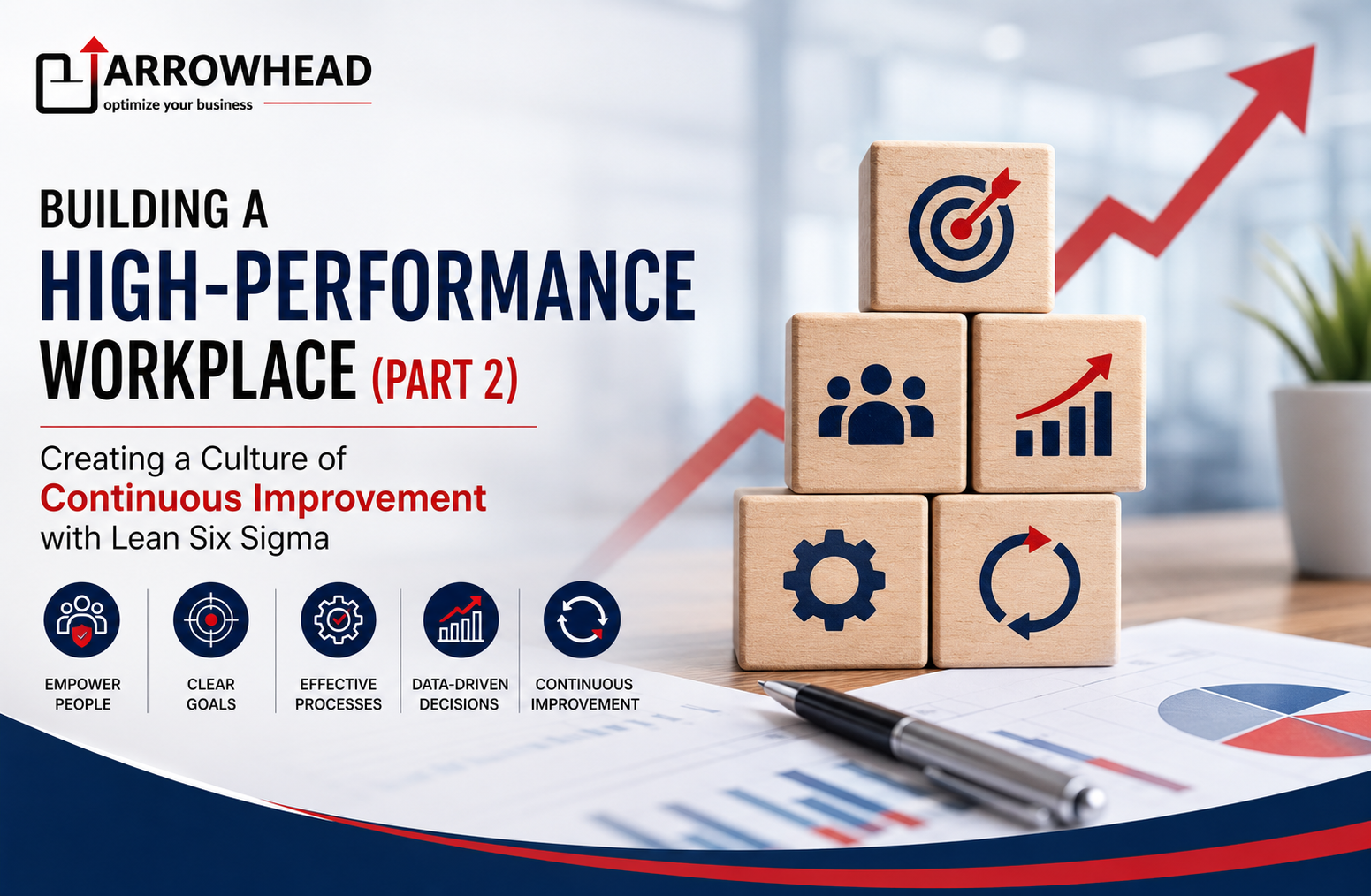
A high-performance workplace is not created by pushing people to work harder, hiring a few exceptional leaders, or running isolated improvement projects. It emerges when the entire operating environment supports people in doing good work consistently -clear goals, shared outcomes, visible processes, employee ownership, and continuous learning.
LEAN provides the philosophy for understanding value, improving flow, and developing people. Six Sigma tools add analytical strength where data and complex process behaviour need deeper investigation. Used together as Lean Six Sigma, they help organizations build more disciplined, connected, and capable workplaces.
At ARROWHEAD Consulting, this is how we see operational excellence -not as a collection of projects or a certification exercise, but as the continuous development of an organization that can align better, solve faster, and perform consistently. A truly high-performance workplace is not one where a few people repeatedly save the day. It is one where people, processes, and decisions work together so effectively that constant rescue is no longer required. That is when high performance stops being an ambition and becomes the way the organization works.