
Introduction – When Knowing More Doesn’t Mean Doing Better
Organisations today are not short of data.
- They have dashboards.
- They have reports.
- They have analytics tools.
- They have AI models generating predictions and insights at scale.
In fact, most leaders will agree that they are seeing more information than ever before.
And yet, performance doesn’t always improve.
- Decisions are delayed.
- Problems repeat themselves.
- Opportunities are missed.
- Execution feels inconsistent.
This raises a critical question:
If organisations have so much insight, why does performance still fall short?
The answer is uncomfortable but important.
Insight does not create impact. Action does.
And the gap between the two, the space where insights fail to translate into decisions and decisions fail to translate into execution, is where most organisations struggle.
At ARROWHEAD Consulting, we encounter this gap across industries. As an experienced Lean consultant in India, a trusted Six Sigma company in Mumbai, and one of the leading Six Sigma Consultants in India, ARROWHEAD works with organisations that are not just looking to generate insights but to act on them consistently and effectively.
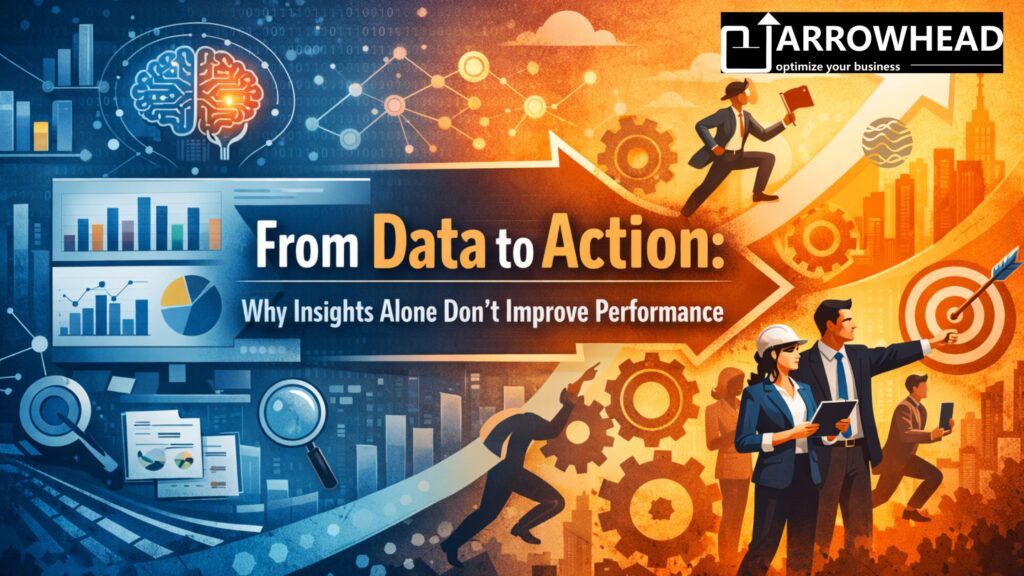
This blog explores why insights alone don’t improve performance, what creates the “data-to-action gap,” and how organisations can build systems that convert intelligence into real results.
The Illusion of Insight-Led Performance
Many organisations believe that better data automatically leads to better decisions.
So they invest in:
- Advanced analytics platforms
- Business intelligence tools
- AI and machine learning models
- Real-time dashboards
These investments create visibility, but not necessarily action.
What often happens instead is:
- More data leads to more discussions
- More discussions lead to delayed decisions
- Delayed decisions lead to missed impact
In some cases, the abundance of insight actually slows organisations down.
This is because unstructured data creates noise rather than clarity.
As a Lean consultant in India, ARROWHEAD often observes that organisations try to solve execution problems with more analytics, when the real issue lies in decision systems and process discipline.
Understanding the Data-to-Action Gap
The gap between insight and performance typically exists across three stages:
1. Insight to Decision
Organisations generate insights but struggle to decide:
- What matters most
- What to act on
- What to ignore
This leads to analysis paralysis.
2. Decision to Execution
Even when decisions are made:
- Ownership is unclear
- Priorities conflict
- Teams are misaligned
Execution becomes inconsistent.
3. Execution to Sustained Impact
Even when action is taken:
- Results are not tracked
- Learnings are not captured
- Improvements are not standardised
Impact fades over time.
This is the real bottleneck in modern organisations: not a lack of insight, but a lack of structured action.
Why Insights Alone Don’t Drive Performance
1. Insights Are Not Prioritised
Not all insights deserve action.
But many organisations treat all data as equally important.
Without prioritisation:
- Teams chase multiple directions
- Focus is diluted
- Resources are spread thin
High-performing organisations focus on critical insights that drive business outcomes.
2. Insights Are Not Owned
A dashboard may show a problem, but who is responsible for solving it?
When ownership is unclear:
- Issues remain visible but unresolved
- Accountability is diffused
- Action is delayed
As a Six Sigma company in Mumbai, ARROWHEAD emphasises clear ownership at every level, because visibility without responsibility creates stagnation.
3. Insights Are Not Integrated into Workflows
Many insights live in dashboards, not in day-to-day work.
Teams continue operating based on:
- Habit
- Experience
- Urgency
Rather than data.
This disconnect prevents insights from influencing real decisions.
4. Insights Lack Process Context
- Data shows what is happening.
- But it does not always explain why.
Without process understanding:
- Root causes remain hidden
- Solutions are superficial
- Problems recur
This is where Lean and Six Sigma become critical.
As leading Six Sigma Consultants in India, ARROWHEAD bridges data and process thinking, ensuring insights lead to meaningful action.
The Role of Lean in Converting Insight into Action
Lean thinking is fundamentally about flow and clarity.
It helps organisations:
- Identify where work slows down
- Make problems visible
- Simplify decision-making
Remove unnecessary steps
In the context of data, Lean answers:
“Where in the process should this insight be acted upon?”
For example:
A delay metric becomes actionable only when linked to a specific process step
A defect rate becomes meaningful only when tied to a root cause
As a Lean consultant in India, ARROWHEAD ensures that insights are embedded in workflows rather than isolated in reports.
The Role of Six Sigma in Driving Data-Based Decisions
While Lean focuses on flow, Six Sigma brings discipline and rigour.
It ensures that:
- Data is validated
- Variation is understood
- Root causes are identified
- Solutions are statistically sound
Six Sigma transforms data from:
Observation → Understanding → Control
This is why organisations that partner with a Six Sigma company in Mumbai, such as ARROWHEAD, can move beyond surface-level insights and build repeatable decision-making systems.
From Dashboards to Decisions: What High-Performing Organisations Do Differently
Organisations that successfully convert insights into action follow a few key principles:
1. They Define Clear Decision Points
They know:
- When decisions need to be made
- Who makes them
- What data is required
2. They Align Data with Business Outcomes
Metrics are not tracked for visibility; they are tracked for action.
Each KPI answers:
What should we do differently?
3. They Integrate Data into Daily Management
Data is not reviewed monthly.
It is used daily.
- Daily huddles
- Weekly reviews
- Real-time alerts
This creates rhythm and discipline.
4. They Build Cross-Functional Alignment
Insights are shared across functions.
- Sales align with operations
- Operations align with the supply chain
- Finance aligns with performance
This reduces conflict and improves execution.
The ARROWHEAD Consulting Approach: Bridging Insight and Execution
At ARROWHEAD Consulting, the focus is not just on generating insights, but on ensuring they lead to measurable action.
The approach includes:
1. Mapping Insights to Value Streams
Understanding where insights fit within end-to-end processes.
2. Defining Ownership
Assigning responsibility for every critical metric.
3. Embedding Decision Systems
Creating structured routines for acting on data.
4. Integrating Lean and Six Sigma
Combining flow optimisation with data discipline.
5. Sustaining Through Governance
Ensuring improvements are tracked and maintained.
This is what differentiates ARROWHEAD as a trusted Lean consultant in India and as one of the most effective Six Sigma Consultants in India.
Why AI Alone Cannot solve the Problem
With the rise of AI, many organisations believe automation will solve the data-to-action gap.
AI can:
- Generate insights faster
- Predict outcomes
- Identify patterns
But AI cannot:
- Align teams
- Define ownership
- Enforce discipline
- Drive execution
Without process clarity and structured decision-making, AI simply accelerates confusion.
This is why organisations continue to rely on a Six Sigma company in Mumbai, such as ARROWHEAD, to ensure that technology is supported by strong operational foundations.
The Cultural Shift: From Reporting to Acting
To truly close the data-to-action gap, organisations must shift their mindset.
From:
- Reporting → Acting
- Monitoring → Improving
- Observing → Owning
This requires:
- Leadership commitment
- Clear accountability
- Consistent follow-through
Culture changes when behaviour changes, and behaviour changes when systems support it.
What Happens When Organizations Get This Right
When insights consistently translate into action:
- Decisions become faster
- Execution becomes predictable
- Problems are solved at the root
- Performance improves sustainably
Organisations stop reacting and start operating with control.
This is the true goal of operational excellence.
Conclusion – Insight Is Only the Beginning
In today’s data-rich world, having insight is no longer a competitive advantage.
Acting on insight is.
Organisations that succeed are not those that collect the most data, but those that:
- Prioritize effectively
- Decide quickly
- Execute consistently
- Learn continuously
At ARROWHEAD Consulting, this is the core focus.
As a leading Lean consultant in India, a trusted Six Sigma company in Mumbai, and one of the most experienced Six Sigma Consultants in India, ARROWHEAD helps organisations move beyond dashboards and reports toward systems that drive real performance.
Because in the end, insight does not improve performance.
Action does.