
Introduction – Why Performance Breaks at the Seams, Not at the Surface
When organisations struggle with performance, the first instinct is to look inward, at individual teams, processes, or functions.
Operations blame planning.
Planning blames sales.
Sales blame demand volatility.
Quality blames execution.
Leadership blames resistance to change.
On paper, every department appears competent.
In reality, performance breaks between departments, not within them.
This is the defining challenge of modern organisations.
High performance is no longer about how efficient one function is. It is about how well the organisation works as a system, how decisions flow across functions, how priorities are aligned, and how data fosters shared understanding rather than fragmented opinions.
This is where most improvement initiatives quietly fail.
At ARROWHEAD Consulting, we’ve seen this repeatedly across industries. As a seasoned Lean consultant in India and a trusted Six Sigma company in Mumbai, ARROWHEAD works with organisations that are not chasing short-term efficiency, but seeking operational excellence that lasts, excellence that survives leadership changes, market shocks, and growth cycles.
This blog explores what truly defines sustained operational excellence today, why discipline and data must operate across silos, and how organisations build performance systems that work end-to-end rather than in isolation.
Why High Performance Is a System Property, Not a Departmental Achievement
A high-performing organisation is not the sum of high-performing departments.
It is the result of:
- Clear shared goals
- Seamless handoffs
- Aligned incentives
- Transparent data
- Coordinated decision-making
Most organizations optimize locally and suffer globally.
For example:
- Sales maximises bookings without visibility into delivery capacity
- Operations improve efficiency without understanding customer priorities
- Finance tightens controls that slow down execution
- Quality enforces standards without influencing upstream decisions
Each department acts rationally within its boundaries, yet overall performance suffers.
This is why operational excellence must be approached as a system design problem, not a functional improvement exercise.
As a Lean consultant in India, ARROWHEAD focuses on value streams, not org charts, because customers experience organisations horizontally, while most companies are managed vertically.
The Difference Between Operational Improvement and Operational Excellence
Operational improvement delivers gains.
Operational excellence delivers consistency.
Improvement answers:
“Can we make this process better?”
Excellence answers:
“Can we perform well every day, across all functions, without heroics?”
Organisations often confuse the two.
They run projects.
They improve metrics.
They celebrate results.
But when conditions change, demand shifts, leadership rotates, and complexity increases, performance declines again.
Operational excellence that lasts requires:
- Disciplined ways of workin
- Shared performance language
- Reliable decision rhythms
- Data that connects functions
- Leadership alignment across silos
This is the mindset ARROWHEAD brings as a Six Sigma company in Mumbai, moving organisations from episodic improvement to institutionalised performance.
Discipline: The Invisible Backbone of High-Performance Organisations
Discipline is often misunderstood as rigidity or control. In high-performing organisations, discipline is something very different.
It is:
- Clarity about how decisions are made
- Consistency in how performance is reviewed
- Reliability in how issues are escalated
- Predictability in how teams interact
Discipline is most evident between departments.
For example:
- Do handoffs follow agreed-upon rules?
- Are priorities negotiated or imposed?
- Is data interpreted the same way across teams?
- Are conflicts resolved through facts or hierarchy?
Without discipline at these interfaces, organisations rely on escalation and personal relationships to function, a fragile and unsustainable model.
As a Lean consultant in India, ARROWHEAD helps organisations define and institutionalise cross-functional disciplines that reduce friction and enable speed.
Why Data Must Unite the Organisation, Not Divide It
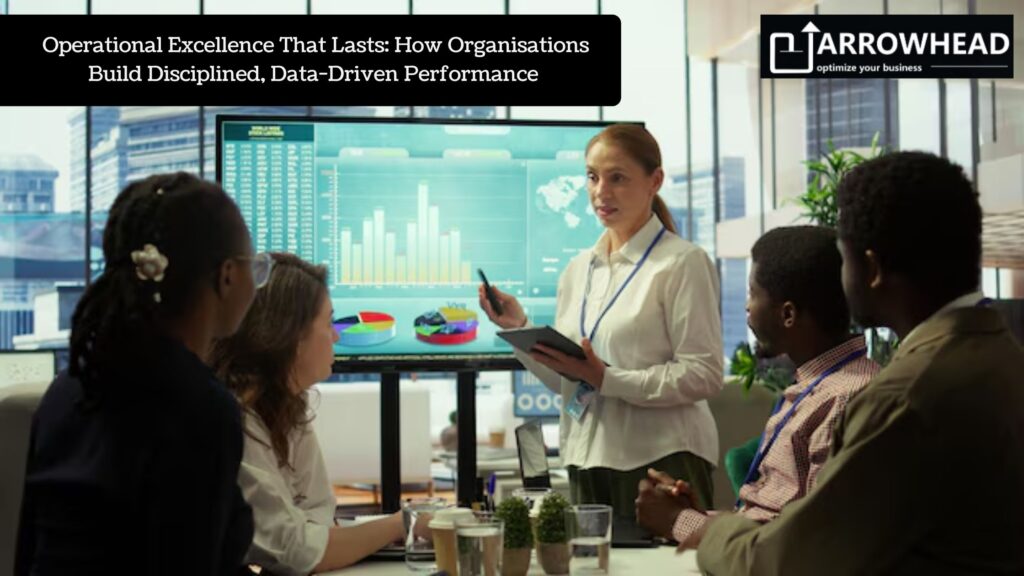
Most organisations are data-rich and insight-poor.
Each function has its own dashboards:
- Sales tracks revenue
- Operations tracks efficiency
- Finance tracks cost
- Quality tracks defects
The problem is not measurement; it’s misalignment.
When departments optimise different metrics, they unintentionally work against each other.
High-performing organisations use data differently.
They:
- Define shared outcome metrics
- Align functional KPIs to end-to-end value
- Use data to resolve conflict, not fuel it
- Create a single version of operational truth
This is where Six Sigma thinking becomes critical, not as a project methodology, but as a decision discipline.
As a Six Sigma company in Mumbai, ARROWHEAD emphasises:
- Clear CTQs that matter across functions
- Process-level metrics, not just outcome numbers
- Fact-based problem resolution at interfaces
Data, when designed correctly, becomes a bridge between departments, not a battleground.
Inter-Departmental Excellence: Where Most Organisations Struggle
The hardest part of operational excellence is not improving processes; it is improving relationships between functions.
Common failure points include:
- Unclear ownership at handoffs
- Competing priorities
- Delayed decision-making
- Blame during failures
- Lack of shared context
High-performing organisations address this by:
- Making interfaces explicit
- Designing cross-functional workflows
- Establishing joint performance reviews
- Clarifying escalation paths
- Encouraging shared accountability
This is why ARROWHEAD Consulting designs excellence programs around value streams and operating rhythms, not departments.
As Lean consultants in India, we focus on how work flows between teams because that’s where value is created or destroyed.
Leadership’s Role in Sustaining Excellence
Operational excellence does not sustain itself.
Leaders shape it through:
- The questions they ask
- The data they trust
- The behaviours they tolerate
- The trade-offs they make
In high-performing organisations:
- Leaders demand facts, not narratives
- Cross-functional issues are addressed openly
- Performance reviews focus on system health
- Success is shared, not siloed
When leaders reinforce functional silos, even unintentionally, operational excellence erodes.
As a Six Sigma company in Mumbai, ARROWHEAD works closely with leadership teams to align governance, reviews, and incentives to support system-level performance, not departmental optimisation.
From Projects to Operating Model
One of the biggest misconceptions is that operational excellence is achieved through projects.
Projects help, but they are not enough.
Lasting excellence requires changes in the operating model, including:
- How priorities are set
- How work is coordinated
- How decisions are made
- How performance is reviewed
- How learning happens
Projects deliver improvement.
Operating models sustain it.
This is where many organisations fall short, and where ARROWHEAD’s experience as a Lean consultant in India becomes critical.
What High-Performance Organisations Do Differently
Organisations that sustain excellence consistently demonstrate these behaviours:
- They manage end-to-end, not function to function
- They review performance frequently and factually
- They resolve conflicts through data, not power
- They invest in capability across roles
- They treat excellence as daily work, not initiative
There is less drama.
Less escalation.
More predictability.
Performance becomes boring, and that is a good thing.
The ARROWHEAD Consulting Approach to Excellence That Lasts
ARROWHEAD does not impose frameworks.
We design systems that fit the organisation.
Our approach focuses on:
- End-to-end value clarity
- Cross-functional alignment
- Data-driven decision architecture
- Disciplined operating rhythms
- Leadership behaviour alignment
- Capability building across functions
This is why organisations work with ARROWHEAD not just as consultants, but as long-term partners in performance.
As a trusted Lean consultant in India and a results-driven Six Sigma company in Mumbai, ARROWHEAD helps organisations move from fragmented excellence to integrated, sustainable performance.
Why Excellence Must Be Designed, Not Demanded
You cannot demand excellence from teams trapped in misaligned systems.
You must design:
- Clear interfaces
- Shared metrics
- Transparent data
- Disciplined routines
- Supportive leadership behaviours
When systems are well designed, people perform consistently.
This is the essence of lasting operational excellence.
Conclusion – High Performance Lives Between Departments
High-performing organisations are not those with the best tools or smartest people.
They are the ones that:
- Align functions around shared outcomes
- Use data to create clarity
- Embed discipline into daily work
- Lead with system thinking
- Treat excellence as an operating principle
At ARROWHEAD Consulting, we believe operational excellence is not about doing more; it’s about working better together.
As a seasoned Lean consultant in India and a trusted Six Sigma company in Mumbai, ARROWHEAD helps organisations design performance systems that don’t depend on individual effort, heroic leadership, or temporary focus.
Because excellence is built into how the organisation works.
It doesn’t fade. It endures.