
Introduction – When Training Feels Valuable but Hard to Justify
Most organisations believe in training.
They invest in workshops, certifications, leadership programs, and capability-building initiatives. Employees attend sessions, learn frameworks, and often return energised.
Yet when budgets are reviewed, one question consistently surfaces:
“What is the actual return on all this training?”
It’s a fair question, and an important one.
Training feels valuable, but its impact is often difficult to quantify. Unlike capital investments or technology upgrades, the benefits of training are not always immediately visible on financial statements.
And this is where many organisations struggle.
Lean Six Sigma training, in particular, is often seen as:
- A certification exercise
- A skill-building initiative
- A long-term cultural investment
But rarely is it measured as a direct contributor to business performance.
At ARROWHEAD Consulting, the narrative changes. As an experienced Lean consultant in India and a trusted Six Sigma company in Mumbai, ARROWHEAD approaches capability building with a clear principle:
Training must not only build knowledge but also create measurable business value.
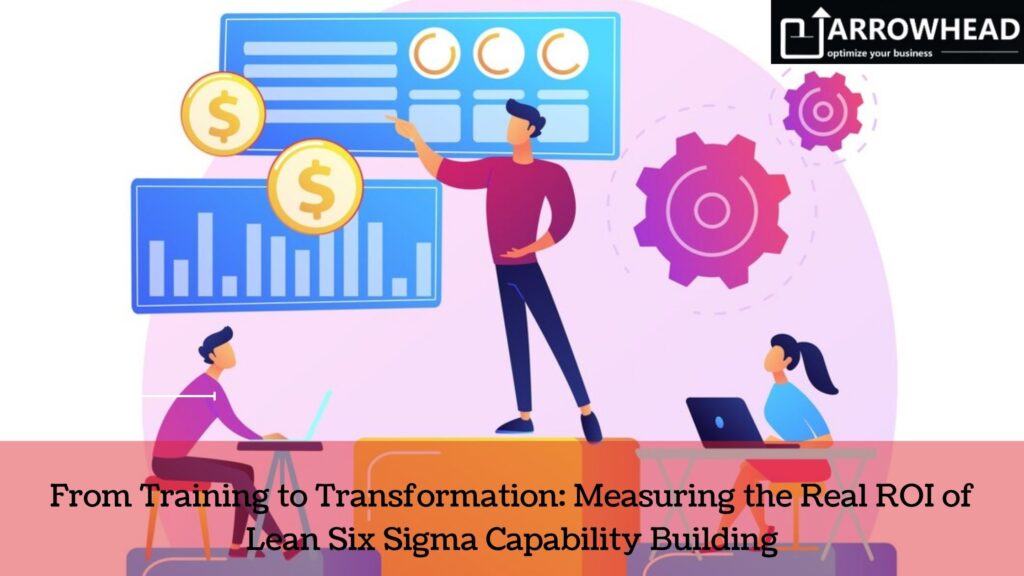
This blog explores how organisations can move from viewing Lean Six Sigma training as a cost centre to recognising it as a high-return investment, and more importantly, how to measure that return in real, business-relevant terms.
Why ROI in Training Is Often Misunderstood
The challenge with training ROI is not that it doesn’t exist; it’s that it is not structured for visibility.
Most organisations evaluate training using:
- Attendance
- Feedback scores
- Completion rates
- Certification counts
While these metrics indicate participation, they do not reflect impact.
This creates a disconnect:
- HR sees engagement
- Participants see learning
- Leadership sees cost
The missing link is business value.
Lean Six Sigma training is uniquely positioned to bridge this gap because it is not just about learning tools but about applying those tools to solve real business problems.
Organisations working with a capable Lean consultant in India often realise that ROI becomes visible only when training is connected directly to execution and outcomes.
Reframing Lean Six Sigma Training: From Learning to Capability
To understand ROI, we must first redefine what Lean Six Sigma training really represents.
It is not:
- A classroom experience
- A certification milestone
- A theoretical exercise
It is:
- A capability-building system
- A way to embed structured problem-solving
- A method to improve decision-making
- A foundation for continuous improvement
When organisations shift from “training programs” to capability development, the conversation changes from:
“What did we teach?”
to
“What did we improve?
As a Six Sigma company in Mumbai, ARROWHEAD Consulting focuses on this exact shift, ensuring that training leads to application and application leads to measurable outcomes.
Understanding ROI in Lean Six Sigma Training
Return on Investment (ROI) in Lean Six Sigma training can be understood as:
The financial and operational value generated by applying learned skills relative to the investment in training.
This value typically emerges from three key sources:
1. Project-Based Financial Impact
Lean Six Sigma training is often linked to improvement projects.
These projects generate:
- Cost savings
- Productivity gains
- Waste reduction
- Quality improvements
For example:
- A defect reduction project lowers rework cost
- A cycle time improvement increases throughput
- A process optimisation reduces labour effort
These benefits can be directly quantified and linked to training.
2. Operational Efficiency Gains
Even beyond projects, trained employees improve how work is done daily.
This leads to:
- Faster problem resolution
- Reduced downtime
- Better resource utilization
- Improved process stability
These gains may not always appear immediately in financial statements, but they contribute significantly to long-term performance.
3. Strategic Capability Development
Lean Six Sigma training builds:
- Analytical thinking
- Data-driven decision-making
- Structured problem-solving
Over time, this reduces dependency on external support and strengthens internal capability.
Organisations that partner with a strong Lean consultant in India often find that this internal capability becomes one of their most valuable long-term assets.
How to Measure ROI from Lean Six Sigma Training
Measuring ROI requires a structured approach. It cannot be an afterthought.
1. Link Training to Business Priorities
Training should be aligned with:
- Cost reduction goals
- Productivity targets
- Quality improvement objectives
- Customer experience initiatives
When training aligns with business priorities, its impact becomes easier to track.
2. Integrate Projects into Training Programs
The most effective Lean Six Sigma training programs include live projects.
Participants apply what they learn to real business problems.
Each project becomes:
- A learning exercise
- A performance improvement initiative
- A source of measurable ROI
This is a key principle that any effective Six Sigma company in Mumbai follows.
3. Quantify Financial Benefits of Projects
For each project, organisations should track:
- Cost savings
- Revenue impact
- Productivity improvements
- Inventory reduction
- Risk mitigation
Finance teams should validate these numbers to ensure credibility.
4. Track Before-and-After Performance
Baseline data is critical.
Without it, improvement cannot be measured.
Organisations should capture:
- Current performance levels
- Target improvements
- Actual results
This ensures transparency and accountability.
5. Calculate ROI
ROI can be calculated using a simple formula:
ROI = (Total Financial Benefits – Training Cost) / Training Cost
Training cost includes:
- Program fees
- Participant time
- Implementation support
Financial benefits include:
- Project savings
- Efficiency gains
- Revenue increases
When structured correctly, Lean Six Sigma training often delivers multiples of the initial investment.
Direct vs Indirect ROI
Not all benefits are immediately financial.
Direct ROI
- Cost reduction
- Increased revenue
- Reduced inventory
Indirect ROI
- Improved employee capability
- Faster decision-making
- Better collaboration
- Reduced dependency on consultants
While indirect benefits are harder to quantify, they significantly enhance long-term performance.
As a Lean consultant in India, ARROWHEAD ensures both types of benefits are recognised and communicated.
Why Many Organizations Fail to Capture Training ROI
Common reasons include:
- Training disconnected from real work
- No project integration
- Lack of financial validation
- Poor data tracking
- No ownership of outcomes
In such cases, training becomes an expense rather than an investment.
The ARROWHEAD Consulting Approach to ROI-Driven Capability Building
ARROWHEAD Consulting designs Lean Six Sigma training programs with ROI in mind from the beginning.
The approach includes:
1. Business-Aligned Training Design
Training topics are selected based on real business needs.
2. Project-Based Learning
Every participant works on a real improvement project.
3. Financial Validation
Finance teams validate project benefits.
4. Continuous Coaching
Participants receive guidance to ensure successful implementation.
5. Leadership Involvement
Leaders track and review outcomes.
This structured approach ensures that training leads to measurable business impact.
As a trusted Six Sigma company in Mumbai, ARROWHEAD focuses on outcomes, not just learning.
Case Example – Turning Training into Measurable Value
Consider an organisation that trained its mid-level managers in Lean Six Sigma.
Instead of stopping at certification, each participant led a project.
Results included:
- Reduction in process delays
- Improved productivity
- Lower operational costs
When aggregated, the total financial benefit exceeded the cost of training several times over.
This is what true ROI looks like, not theoretical value, but measurable impact.
Why Leadership Must Redefine How Training Is Evaluated
For training ROI to become visible, leadership must shift its perspective.
Instead of asking:
- “How many people were trained?”
Leaders must ask:
- “What business problems were solved?”
- “What financial value was created?”
- “How has capability improved performance?”
Organisations that work with a strong Lean consultant in India often make this shift and see a significant change in how training is perceived.
The Long-Term Impact of Lean Six Sigma Capability Building
Beyond immediate ROI, Lean Six Sigma training creates:
- A culture of continuous improvement
- Stronger problem-solving capability
- Better cross-functional collaboration
- Increased organizational resilience
These benefits compound over time.
Training, when done right, becomes a strategic asset, not a recurring cost.
Conclusion – From Training Expense to Business Investment
Lean Six Sigma training should never be justified by attendance or feedback scores.
Its true value lies in:
- Problems solved
- Processes improved
- Costs reduced
- Revenue enabled
At ARROWHEAD Consulting, capability building is designed to deliver exactly this.
As a leading Lean consultant in India and a trusted Six Sigma company in Mumbai, ARROWHEAD helps organisations ensure that training moves beyond the classroom and into real business impact.
When training is aligned with execution and measured by outcomes, it stops being an expense and becomes one of the highest-return investments an organisation can make.