
Introduction – People Rarely Resist Change. They Resist Uncertainty.
Every organisation wants to improve.
Leadership teams invest in digital transformation, operational excellence, automation, process improvement, and Lean Six Sigma initiatives with one common expectation: better business performance.
The plans are usually well thought out.
The business case is convincing.
The objectives are clear.
Yet many transformation initiatives struggle long before the technical work begins.
Not because the methodology is wrong.
Not because the tools are ineffective.
But because the people expected to make the change happen are not fully committed to it.
Walk into almost any organisation beginning a transformation journey, and you will hear familiar questions:
“Why are we changing this?”
“We’ve always done it this way.”
“This is just another management initiative.”
“Will this create more work for us?”
“Will this still matter six months from now?”
These questions are rarely signs of laziness or resistance.
More often, they reflect uncertainty.
People want to understand what is changing, why it matters, how it affects their work, and whether leadership is genuinely committed.
At ARROWHEAD Consulting, we have seen that the success of a Lean Six Sigma transformation depends as much on people as it does on processes. As an experienced Lean consultant in India, ARROWHEAD helps organisations build operating systems that improve performance while also creating the leadership behaviours and employee engagement needed to sustain change.
This blog explores why employee buy-in is essential for Lean Six Sigma success and how leaders can create an environment where people don’t simply comply with change but actively contribute to it.
Why Good Improvement Programs Often Lose Momentum
Many organisations assume that once the strategy has been approved, the rest will naturally follow.
A project team is formed.
Training sessions are scheduled.
Improvement targets are announced.
Dashboards are introduced.
Leadership expects momentum.
Instead, progress becomes slower than anticipated.
Participation declines.
Improvement meetings become routine rather than energising.
Teams continue working the way they always have.
This happens because organisations frequently launch Lean Six Sigma initiatives as operational projects instead of organisational change journeys.
Processes can be redesigned quickly.
Mindsets cannot.
True transformation requires employees to understand not only what is changing but also why it deserves their commitment.
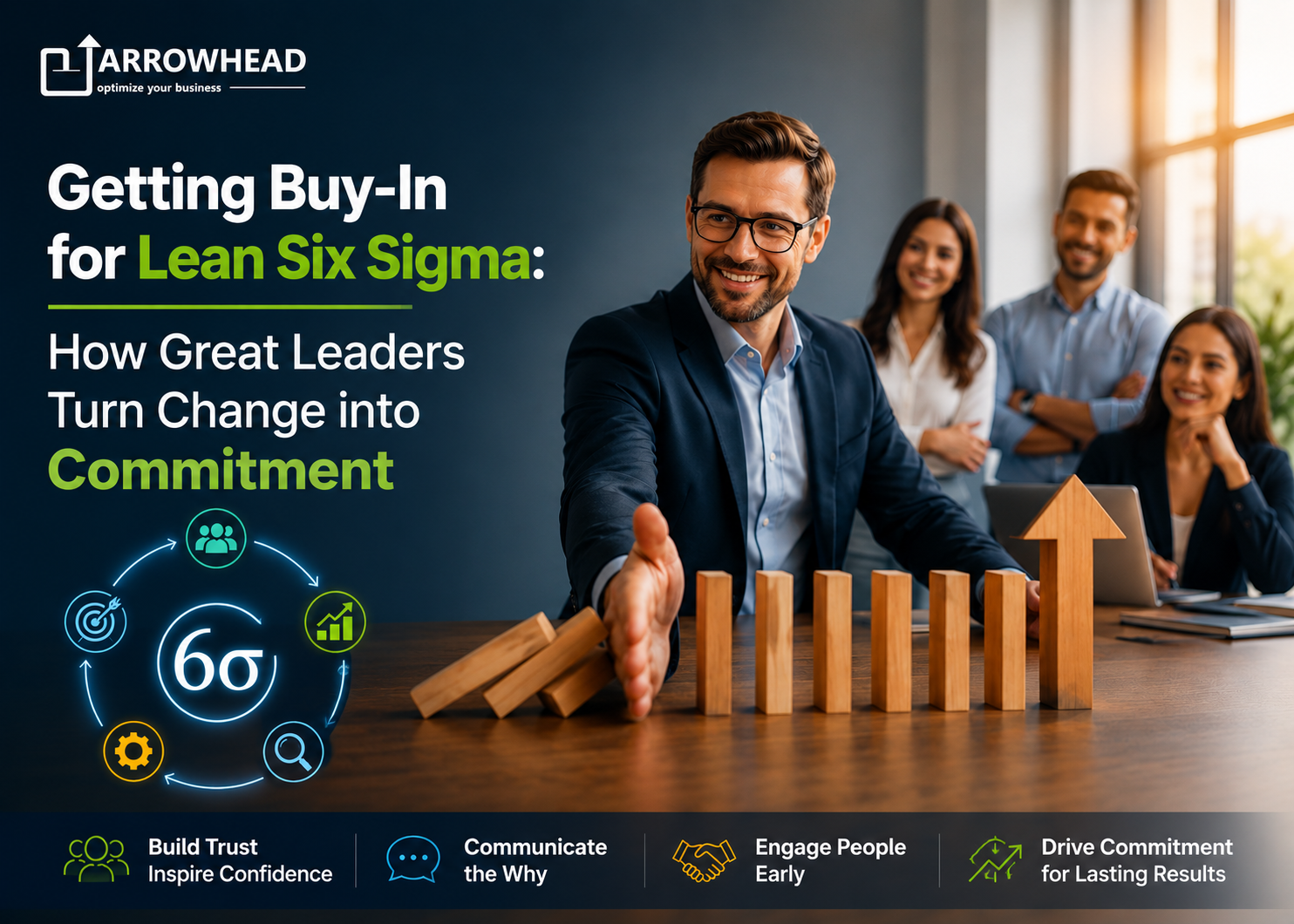
Buy-In Is Not Agreement. It Is Belief
One of the biggest misconceptions about change management is that employee buy-in means everyone agrees with every decision.
That is rarely realistic.
Buy-in is something deeper.
It means people believe:
- the change has a meaningful purpose
- leadership is committed
- their contribution matters
- the process will be fair
- improvement is not temporary
When these beliefs exist, employees become participants instead of observers.
This distinction is critical.
Compliance creates short-term implementation.
Commitment creates long-term transformation.
LEAN thinking has always recognised this difference by placing respect for people alongside continuous improvement.
Lean Six Sigma is not only about improving processes.
It is equally about developing the people responsible for those processes.
Why Employees Resist Change
Resistance is often misunderstood.
Leaders sometimes assume that resistance stems from an unwillingness to improve.
In reality, employees usually resist because they fear losing something valuable.
They may fear:
- losing confidence
- losing control
- losing familiar routines
- losing influence
- making mistakes publicly
- being judged unfairly
These concerns are entirely human.
A Lean Six Sigma transformation that ignores these emotions may achieve technical improvements but struggle to create lasting behavioural change.
The most successful leaders acknowledge these concerns instead of dismissing them.
Start with Purpose, Not Tools
One of the quickest ways to lose buy-in is to introduce tools before explaining the purpose.
Imagine telling employees:
“We’re introducing Value Stream Mapping.”
Or:
“We’ll now use DMAIC.”
Most employees immediately wonder:
“What does that mean for me?”
Instead, begin with the business challenge.
For example:
“Our customers are waiting too long.”
“Our teams spend too much time correcting preventable errors.”
“We want to remove unnecessary work so people can focus on higher-value activities.”
Once people understand the purpose, Lean Six Sigma tools become enablers rather than additional tasks.
This is one reason ARROWHEAD Consulting always begins transformation conversations with business outcomes, not methodology.
Leadership Behaviour Sets the Tone
Employees pay far more attention to leadership behaviour than leadership presentations.
If leaders talk about continuous improvement but continue rewarding firefighting, employees notice.
If leaders encourage openness but react negatively when problems are raised, employees notice.
If leaders ask for innovation but discourage experimentation, employees notice.
Consistency builds credibility.
In successful Lean Six Sigma environments, leaders:
- ask questions instead of assigning blame
- encourage visibility of problems
- celebrate learning, not only success
- participate in improvement activities
- remove barriers instead of creating them
These behaviours demonstrate that Lean Six Sigma is not another management initiative but a different way of operating.
Involve People Early
One of the fastest ways to create resistance is to involve employees only after major decisions have already been made.
People support what they help create.
When employees contribute to:
- identifying waste
- mapping processes
- prioritising improvements
- testing solutions
they develop ownership naturally.
This is a core principle of Lean thinking.
The people doing the work usually understand the work better than anyone else.
Ignoring their experience weakens both the solution and the commitment behind it.
Communicate the ‘Why’ Repeatedly
Leaders often believe they have communicated enough after one town hall or one presentation.
Employees experience change differently.
People absorb information gradually.
Questions emerge over time.
Priorities evolve.
Successful transformations therefore communicate consistently.
Not by repeating slogans, but by reinforcing:
- why the change matters
- what progress is being made
- what challenges have been encountered
- what has been learned
- how employees are contributing
This ongoing dialogue builds trust.
Create Early Wins That People Can See
Nothing builds belief like visible improvement.
Large transformation programmes can take months or even years.
Employees need evidence that the effort is worthwhile.
Early improvements might include:
- reducing approval time
- simplifying a reporting process
- eliminating repetitive manual work
- improving workplace organisation
- reducing customer response time
These visible wins create confidence.
They demonstrate that Lean Six Sigma is improving everyday work, not simply creating additional documentation.
Develop Capability, Not Dependency
Training should never become an isolated event.
Many organisations send employees to Lean Six Sigma training programmes but provide little opportunity to apply what they learn.
Knowledge fades quickly without application.
Capability grows when employees:
- solve real problems
- receive coaching
- learn from experience
- see measurable outcomes
At ARROWHEAD Consulting, Lean Six Sigma capability building focuses on practical application rather than certification alone.
The objective is to create confident problem-solvers throughout the organisation.
Recognise and Celebrate Improvement
Recognition is often underestimated.
Employees who contribute ideas, solve problems, or improve processes should know their efforts matter.
Recognition does not always require financial rewards.
Often it means:
- sharing success stories
- acknowledging contributions publicly
- giving teams opportunities to present improvements
- celebrating collaborative achievements
This reinforces the message that improvement is everyone’s responsibility.
Address Middle Management Carefully
Many transformation programmes overlook one critical group:
Middle managers.
These leaders often experience the greatest pressure.
They must:
- deliver business results
- support employees
- implement change
- manage uncertainty
Without their commitment, Lean Six Sigma initiatives struggle.
Middle managers need:
- clarity
- coaching
- involvement
- leadership support
When they become advocates rather than reluctant implementers, transformation accelerates significantly.
Lean Six Sigma Is Ultimately About Trust
Successful transformation depends on trust.
Employees must trust that:
- leadership is committed
- improvement will be sustained
- raising problems is safe
- decisions are fair
- learning is encouraged
Trust cannot be created through policies.
It develops through consistent leadership behaviour over time.
LEAN philosophy has always recognised that respect for people is inseparable from operational excellence.
Without trust, continuous improvement becomes difficult to sustain.
The ARROWHEAD Consulting Approach
At ARROWHEAD Consulting, Lean Six Sigma transformations are designed around people as much as processes.
The approach typically includes:
- aligning leadership around a common vision
- involving employees early
- strengthening communication
- building problem-solving capability
- embedding improvement into daily work
- coaching leaders to reinforce new behaviours
- creating systems that sustain engagement beyond the initial project
As a trusted Lean consultant in India, ARROWHEAD believes lasting transformation happens when people understand not just what is changing, but why it matters and how they can contribute.
Conclusion – Commitment Is the Real Driver of Change
Every Lean Six Sigma transformation begins with an improvement opportunity.
But the organisations that achieve lasting success understand something important.
Processes do not improve themselves.
Technology does not change behaviour.
Methodologies do not create commitment.
People do.
When leaders communicate with purpose, involve employees early, build trust, celebrate progress, and demonstrate consistent commitment, Lean Six Sigma becomes more than an improvement initiative.
It becomes part of the organisation’s culture.
At ARROWHEAD Consulting, we believe sustainable operational excellence is created when people are not asked to simply accept change but are empowered to shape it.
Because the strongest transformations are not the ones where employees are told what to do.
They are the ones where employees genuinely believe they are building something better together.