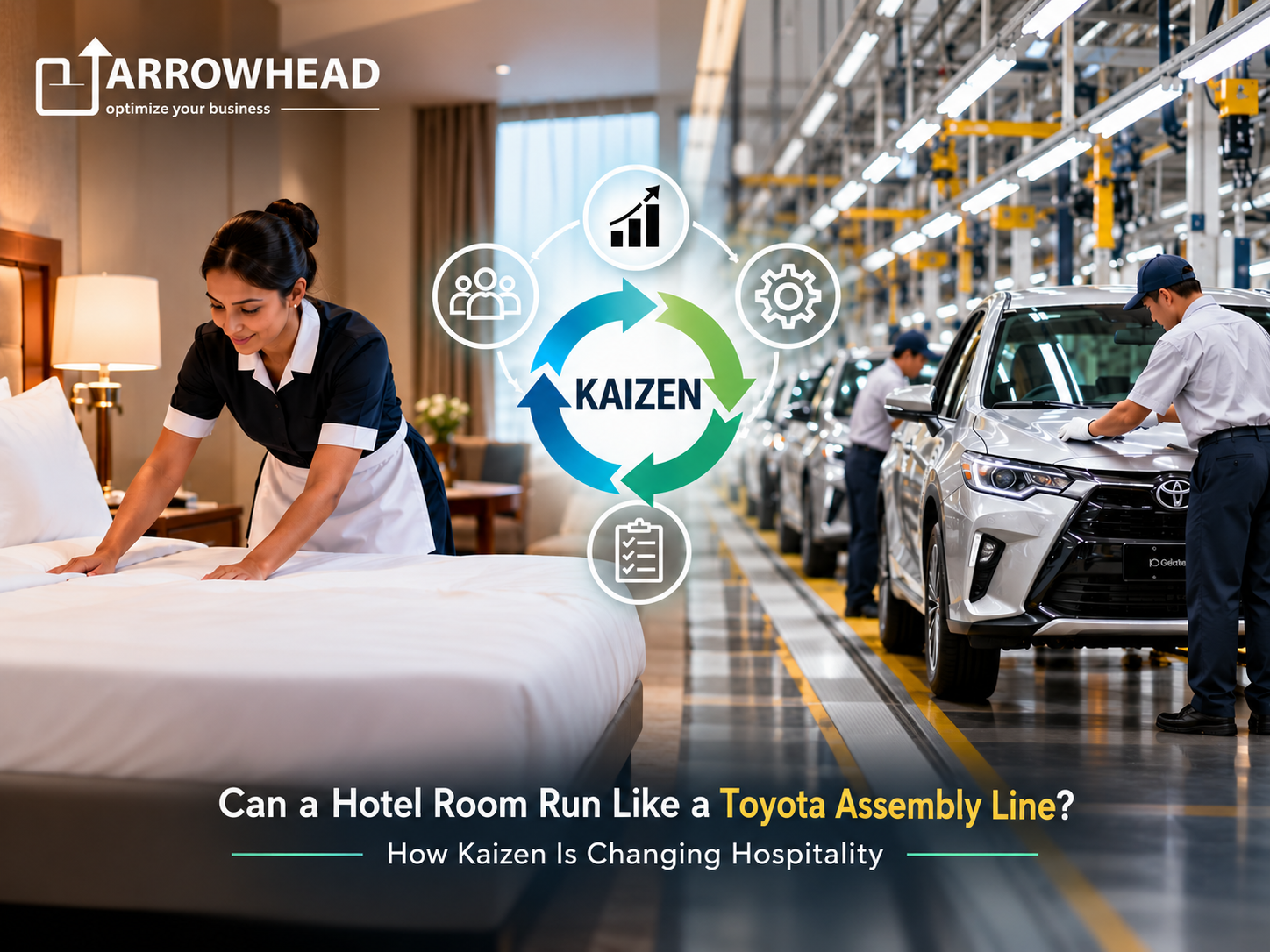

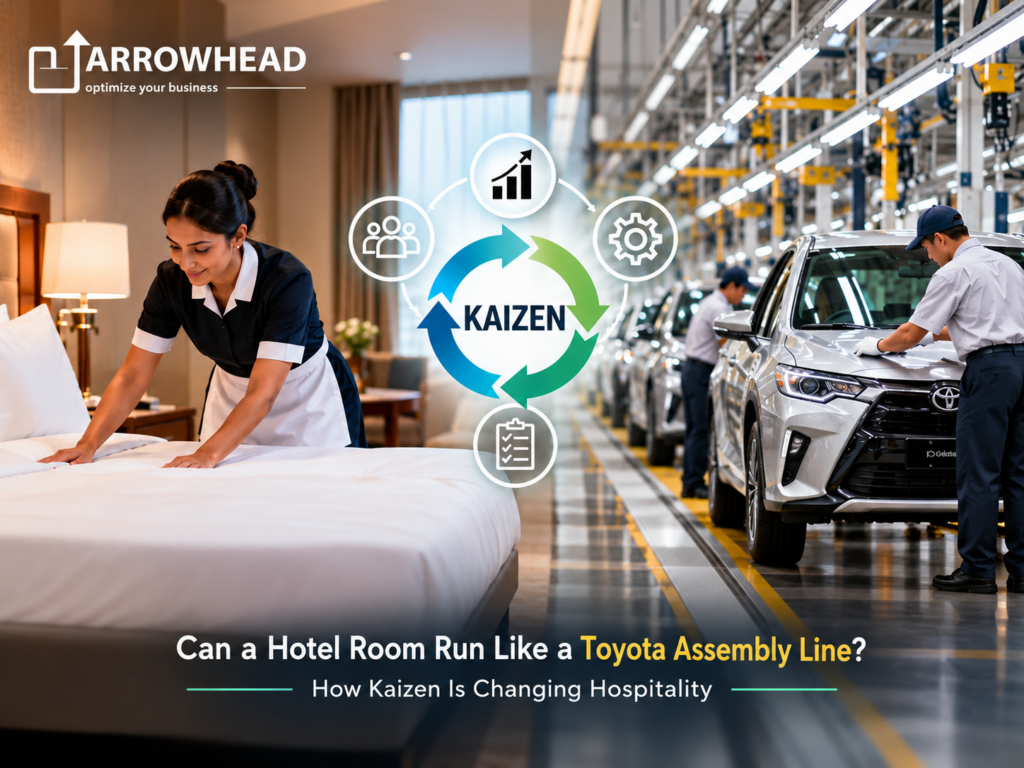
What does a hotel room have in common with a Toyota assembly line?
At first glance, probably nothing.
One produces cars. The other prepares a space for a guest who may have travelled hundreds of kilometres just to relax. But look closer, and an interesting connection appears.
A hotel room goes through its own sequence of activities. One guest checks out, housekeeping enters, linen is changed, surfaces are cleaned, amenities are replenished, the room is inspected, and any maintenance issues are resolved before the next guest arrives.
If even one step gets delayed, the entire process can slow down.
This is where Kaizen, the philosophy of continuous improvement, can offer hospitality something valuable.
Not by turning hotels into factories, but by helping them ask a simple question:
How can we make the work better, one improvement at a time?
That is what makes Kaizen in the hospitality industry so relevant. The goal isn’t to copy manufacturing processes, but to apply the thinking behind them to improve how hotels operate.
What Does Kaizen Mean in Hospitality?
Kaizen is often translated as continuous improvement. But it is about much more than simply making people work faster.
The approach encourages teams to identify problems, improve processes, and involve the people who actually perform the work.
This is particularly relevant to Kaizen in hotels because employees are often the first to notice when a process isn’t working.
A housekeeper may know that a particular room layout causes unnecessary movement. A front desk employee may know exactly where check-in gets delayed. A chef may know why ingredients repeatedly have to be collected from another location.
These employees are not just doing the work.
They are observing the process every day.
Kaizen gives organisations a way to turn those observations into improvements.
How Kaizen in Hotels Can Reduce Everyday Waste
Consider housekeeping.
Preparing a room involves far more than cleaning. Supplies need to be available, linen needs to be replenished, rooms need to be assigned, maintenance issues need to be communicated, and inspections need to happen before the room is released.
Now imagine supplies stored too far away or maintenance issues reported late.
Each problem may seem small.
But when the same issue happens hundreds of times, the lost time and effort can add up quickly.
This is where Kaizen in hotels becomes powerful.
Instead of accepting the process as it is, teams start asking:
Why does this happen? Can we make this easier? Can we remove this step? Can we prevent the problem from happening again?
That is the foundation of continuous improvement in hotels.
The Guest Sees the Experience, Not the Process
Guests do not see everything happening behind the scenes.
They see whether their room is ready when promised. They experience how long check-in takes. They notice whether their request is handled quickly and whether a problem is resolved properly.
Behind each of these experiences is a process involving multiple people and departments.
This means improving the guest experience often starts with improving the work behind it.
For example, if room turnaround is slow, simply asking housekeeping employees to work faster may not solve the problem.
The actual cause could be delayed room allocation, unavailable linen, maintenance handoffs, or inspection delays.
Continuous improvement in hotels means finding the reason behind the delay rather than simply treating its visible symptom.
Look at the Guest Journey, Not Just Individual Departments
Imagine a guest requesting at the front desk.
The request may pass through reception, housekeeping, room service or maintenance before it reaches the guest.
Every department may be doing its job correctly. Yet if the handoff between them is slow, the guest still experiences poor service.
This is why Kaizen in the hospitality industry needs to look beyond individual departments.
Where does information get delayed?
Where does work get repeated?
Where does the guest have to wait?
Where are employees spending time on activities that do not create value?
These questions help organisations understand the entire flow of work.
A good kaizen consultancy approach therefore looks at the complete process rather than trying to improve isolated activities.
Standardisation Does Not Mean Making Hospitality Robotic
Hospitality is personal. Guests have different expectations and situations, so hotels cannot treat every interaction like a production step.
But standardisation still has an important role.
Standardising a process does not mean standardising the human experience.
A hotel can have a consistent process for checking room readiness while still allowing employees to respond personally to guests. It can standardise how maintenance issues are reported without dictating exactly how every guest conversation should happen.
Standardisation creates stability.
Once the basic process is stable, teams have a better foundation for continuous improvement in hotels.
Kaizen Starts With the People Doing the Work
One of the biggest lessons hospitality can take from Toyota is that improvement should not always come from the top.
The people closest to the work often see the problems first.
If a housekeeper finds a better way to organise supplies, the organisation should listen. If a receptionist identifies a recurring check-in bottleneck, the organisation should have a way to investigate it.
This is where Kaizen in hotels becomes as much about people as processes.
Employees are not simply expected to follow a system. They become part of improving it.
That connects with an important Lean principle: respect for people.
Continuous improvement works better when employees are treated as problem-solvers, and their observations are taken seriously.
Small Improvements Can Create Big Results
Kaizen does not always require a major technology investment.
Moving frequently used supplies closer to where they are needed can reduce unnecessary movement. Improving departmental handoffs can reduce delays. Changing a work-area layout can make repetitive tasks easier. Addressing the root cause of a recurring maintenance problem can prevent repeated interruptions.
Each change may appear small.
But when the same process happens hundreds of times, small improvements can create meaningful operational impact.
That is why continuous improvement in hotels should not always mean large transformation projects.
Sometimes, the biggest improvements begin with a small problem that employees notice every day.
Where Kaizen Consultancy Can Help
Hotels often know that something is inefficient, but identifying the real cause can be difficult when teams are focused on daily operations.
This is where Kaizen Consultancy can bring structure to the improvement process.
The focus is on observing how work happens, identifying waste and bottlenecks, involving employees and developing practical improvements.
Lean Six Sigma can also support this when organisations need deeper analysis.
Lean helps identify waste and improve flow, while Six Sigma tools can support data-based analysis, variation and root-cause investigation.
The objective is to move from:
“We think this is the problem.”
to:
“Let’s understand what the process and data are telling us.”
How ARROWHEAD Consulting Brings This Thinking Together
At ARROWHEAD Consulting, we focus on helping organisations build better processes through Lean-led thinking, structured problem-solving, and continuous improvement.
The principles of Kaizen in the hospitality industry can be adapted to service businesses when they are applied thoughtfully.
Hospitality does not need to become a factory.
It needs to become better at identifying what slows people down, what creates unnecessary work, and what affects the guest experience.
That is where a structured kaizen consultancy approach can add value.
The Hotel of the Future May Be More Lean Than It Looks
A hotel does not need robots, conveyor belts, or factory-style production lines to benefit from Kaizen.
It needs people who notice problems, leaders who listen, processes that can be understood, and a culture where improvement is part of everyday work.
That is the real connection between a hotel room and a Toyota assembly line.
Not the work itself, but the mindset behind the work.
The future of Kaizen in the hospitality industry is not about making hotels feel like factories. It is about making them more efficient, consistent, and responsive while keeping the human experience at the centre.
Because the best hotel experience is rarely created by one big improvement.
It comes from hundreds of small improvements that make the experience smoother for the guest and the work better for the people delivering it.
And that is Kaizen at its best.